Selection & calculation
Tunable white, dim-to-warm and full colour: three products that get specified as one
The control, wiring and photometric consequences of each colour-changing architecture, why the efficacy and CRI you were quoted belong to one set point out of hundreds, the Duv drift nobody measures across the tuning range, and how to write a clause that a contractor can price.
"Tunable white" arrives on a schedule as a single line item and covers at least three different products with different channel counts, different wiring, different control protocols and different failure modes. The specification is usually written for one of them and priced against another, and the divergence is discovered at commissioning when somebody asks why the CCT cannot be set independently of the dim level.
Three architectures
Dim-to-warm is a single control channel. Colour temperature is a function of the dim level, following a curve the manufacturer fixed — typically from around 2700 K at full output down towards 1800 K at the bottom, imitating the behaviour of an incandescent lamp on a dimmer. You cannot have it warm and bright. It is a one-channel product on one-channel wiring and one-channel control, and where the application is hospitality or residential, it is often exactly right.
Tunable white is two channels: a warm emitter set and a cool emitter set, mixed independently. CCT and output level are separate variables. This is what most people picture and what most specifications describe, and it needs either a two-channel driver, two drivers, or a DALI device type that handles colour control natively.
Full colour — RGBW and its relatives — is three or more channels and is a different discipline again, with its own calibration, metamerism and consistency problems. Where a project needs white light of a controllable temperature, specifying a colour-mixing fitting to achieve it usually buys a worse white at a higher price.
The control decision drives the wiring, not the other way round
How the channels are addressed decides how many conductors reach the fitting and how many gear positions the ceiling has to accommodate. Three arrangements are common:
- DALI device type 8 (colour control). One DALI address per luminaire handles both level and colour, with the mixing done inside the driver. This is the tidiest arrangement and the one to prefer where the control system supports it; check the device type explicitly, because a DALI driver that is not DT8 will accept level commands and ignore colour ones.
- Two DALI addresses per luminaire. Warm and cool as separate channels, mixed by the controller. It works, it doubles the address count against the 64-per-line limit discussed in DALI-2 commissioning, and it puts the responsibility for the mixing curve on whoever configures the system.
- Two analogue channels. Two 1–10 V circuits, four control conductors, and no feedback. Cheap, robust, and unable to hold a defined CCT across a dimming curve without careful commissioning. See dimming protocol selection for what the analogue interface can and cannot do.
What happens to the photometry as you tune
This is where the specification usually loses contact with the product. A datasheet quotes efficacy, CRI and output at one set point. On a two-channel fitting there are hundreds, and the quoted numbers describe one.
- Output is not additive. Full output on both channels together is not the sum of each channel's rated output, because the driver has a total power budget and typically shares it. The mid-range CCT — the one the office will actually run at — often delivers less than either extreme.
- Efficacy varies across the range. Warm phosphor conversion is less efficient than cool. A fitting quoted at its 4000 K mid point performs differently at 2700 K, and the installed power density you calculated may belong to a set point nobody uses.
- CRI varies too, and usually dips somewhere in the middle of the range where the mix is most unbalanced. If the space has a colour-critical task, the requirement applies across the range, not at the extremes.
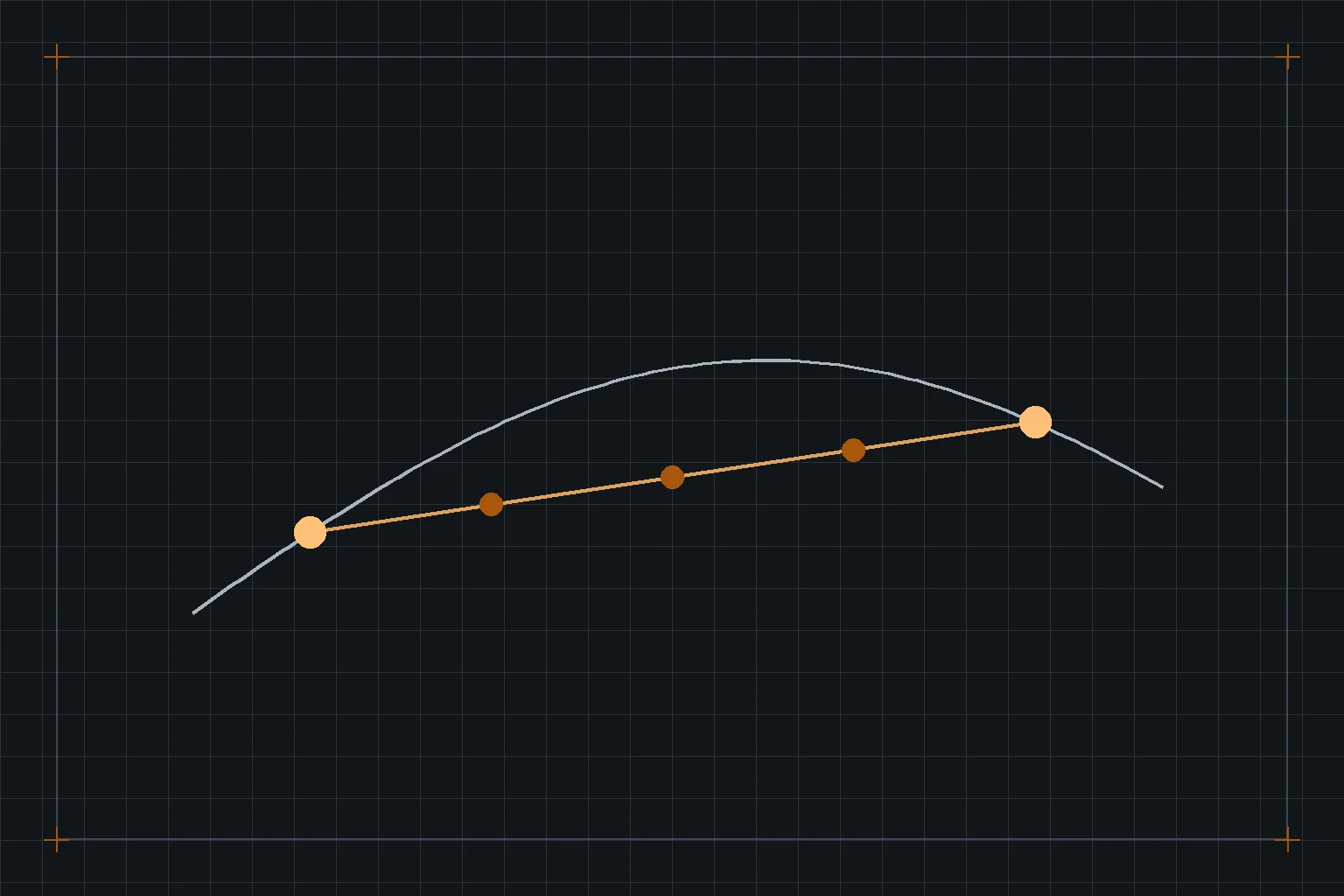
- Duv drifts along the tuning path. A two-channel mix traces a straight line between the two emitters' chromaticities, and the Planckian locus is a curve. The mid-range therefore sits off the locus — usually to the pink side — unless the manufacturer has calibrated the curve to follow it. This is the tint people notice and cannot name, and the mechanism is set out in CCT, Duv and the black-body locus.
A two-channel fitting has two sets of emitter tolerances and a mixing calibration that may or may not be done per unit. Two fittings that match at 4000 K can be visibly apart at 3000 K. Any colour consistency clause has to name the set points it is verified at, or it verifies one point out of the range and implies the rest — see colour consistency and SDCM.
When it is worth the money, and when it is not
Tunable white adds driver cost, control cost, commissioning time and a class of defect that conventional fittings do not have. It earns that in spaces where the colour change serves a defined purpose that somebody has agreed: hospitality and retail where the scene changes with the trading day, healthcare where a schedule is part of the care model, education where teaching modes are defined. In an open-plan office with no schedule and no owner of the settings, it typically ends up parked at one CCT within a month of handover, having been paid for as a variable system.
If the application argument is about occupant wellbeing rather than appearance, the quantities involved are melanopic rather than photometric, they are defined in CIE S 026, and they are not the same thing as colour temperature. A clause requiring "circadian lighting" is unpriceable; a clause requiring a stated melanopic EDI at a stated plane at a stated time of day can be designed to and verified. The distinction, and why photobiological safety is a third separate subject again, is in risk groups on a lighting specification.
A clause that can be priced
- The architecture named: dim-to-warm, two-channel tunable white, or colour mixing — not "tunable".
- The tuning range and the control interface, including the DALI device type where DALI is used, and the address count per luminaire.
- Photometric data at defined set points — at minimum the two extremes and the intended normal operating point — covering output, input power, CRI and chromaticity coordinates. One LM-79 report at one set point does not describe this product.
- A Duv limit that applies across the range, not only at the endpoints.
- The default state on power-up, and the behaviour after a supply interruption. A building whose fittings return to full cool output after every power cut has a control system that will be turned off.
Sources and further reading
- IEC 62386 series — DALI, including the colour control device type used by single-address tunable white gear.
- ANSI C78.377 — chromaticity specification for solid-state lighting; the nominal CCT quadrangles a tuning range passes through.
- IES LM-79 — the measurement that produces output, input power and chromaticity for a given set point.
- CIE S 026 — the metrology of ipRGC-influenced responses to light, for the non-visual quantities that "circadian" claims should be written against.