Metrics & standards
Risk groups on a lighting specification: what IEC 62471 does and does not say
What photobiological safety classification actually measures, why almost every white LED luminaire is RG0 or RG1, the threshold-distance approach in IEC TR 62778, where RG2 genuinely turns up, and how to write the clause without importing consumer blue-light claims into a technical document.
Photobiological safety is the part of a luminaire specification most often either omitted entirely or written in language borrowed from consumer marketing. Both failures have the same root: the classification is widely quoted and rarely read, so "RG1" ends up on a schedule as a reassurance rather than as a requirement with a defined meaning.
What is actually being measured
IEC 62471 assesses optical radiation hazards from lamps and lamp systems across several separate mechanisms — ultraviolet, retinal blue light, retinal thermal, infrared and skin. For white LED lighting, one of them dominates the discussion: the blue light hazard, which is a photochemical effect on the retina, weighted by an action spectrum that peaks in the blue and evaluated as a radiance rather than an illuminance.
Radiance is the key word and the source of most of the confusion. The hazard depends on how concentrated the source appears to the eye, not on how much light the fitting emits in total. A high-output fitting behind a large diffuser can present a lower hazard radiance than a small, bright, unshielded emitter of a fraction of the output. This is why "brighter equals more dangerous" fails as an intuition and why the classification cannot be inferred from a wattage.
The four groups are defined by exposure time before the relevant limit is reached: exempt and Risk Group 1 correspond to no hazard and no hazard under normal behavioural limitations respectively; Risk Group 2 to a hazard from which aversion responses protect you; Risk Group 3 to a hazard on momentary exposure. General lighting products sit at the bottom of that scale, and a general lighting product arriving as RG3 is a product that should not be in a general lighting schedule.
The distance question, and why IEC TR 62778 exists
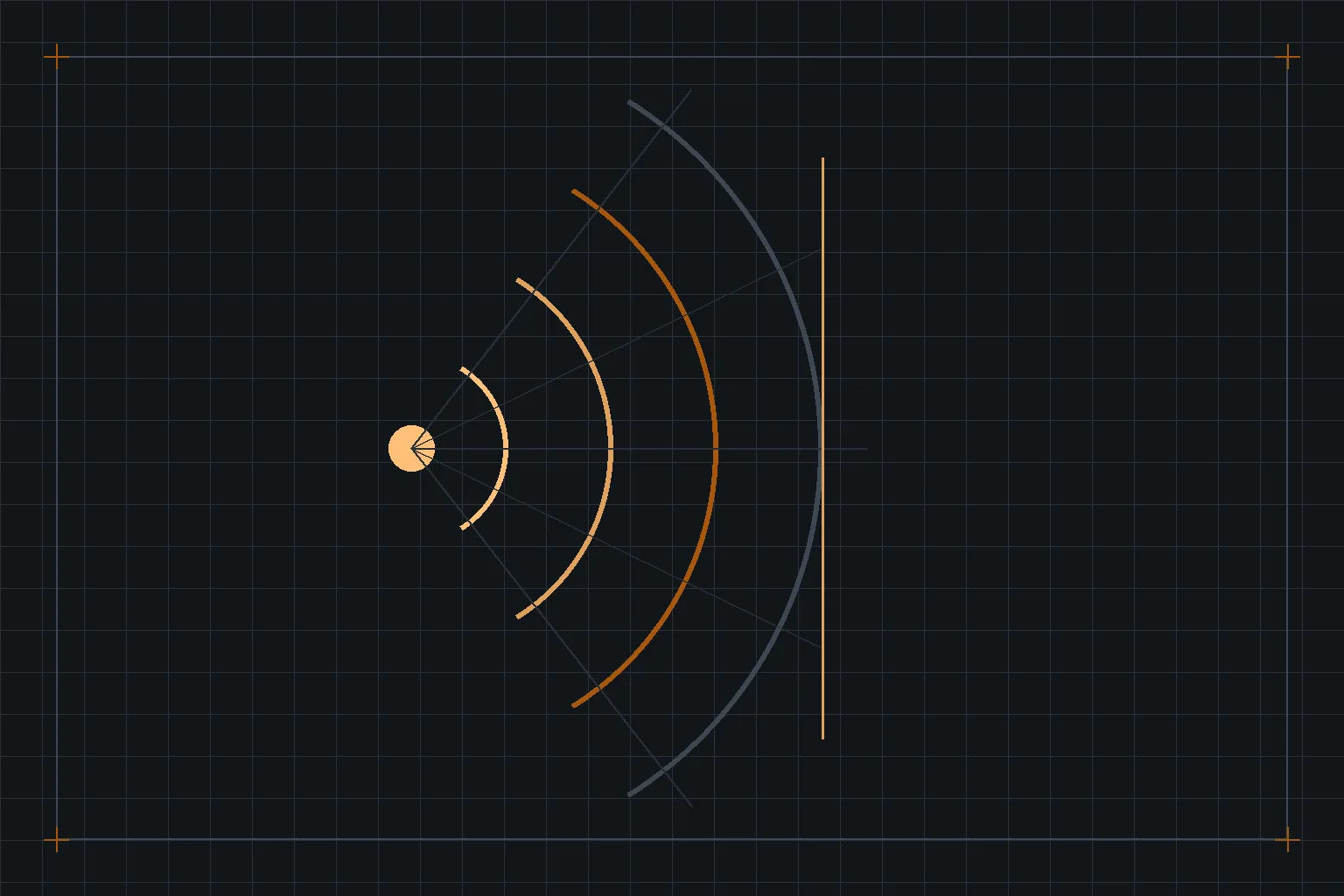
A classification is only meaningful with a distance attached, because radiance falls with the solid angle the source subtends. Assessing every luminaire at the 200 mm reference distance used for lamps produces conservative and largely useless results for architectural fittings that nobody views from 200 mm.
IEC TR 62778 resolves this for luminaires. Rather than classifying the fitting in the abstract, it works from the blue light hazard of the light source and derives the distance beyond which the product is RG1 — the threshold distance. A fitting declared "RG1 beyond 200 mm" and one declared "RG1 beyond 2.5 m" carry very different practical consequences, and both are legitimate declarations. The number to ask for is the threshold distance, not the group alone.
Ask for the classification and the distance in the same sentence: "RG1 at and beyond d mm per IEC TR 62778". A bare "RG1" on a datasheet is an incomplete statement, and where the fitting will be mounted within reach — a task light, a low-level bollard, an under-shelf strip — the distance is the only part of it that matters.
Where it genuinely bites
For the great majority of interior schemes the honest answer is that this clause costs nothing and changes nothing: diffused fittings at ceiling height are RG0 or RG1 at trivial distances. The cases where it does real work are narrower and worth recognising on sight.
- Direct-view sources. Bare COB emitters, decorative fittings with visible LEDs, and anything where the optic does not spread the source over an area.
- Narrow-beam spotlights and accent fittings at short throw. The optic that makes a tight beam also concentrates hazard radiance; the threshold distance can be several metres.
- High-CCT product. More of the output sits in the weighted band, so a 6500 K variant of a family can classify differently from the 3000 K one. Classification belongs to an ordering code, not a product family.
- Spaces occupied by children, or by people who cannot look away. Nurseries, paediatric and care settings, and any application where the source will sit in the field of view of someone lying down. Aversion response is part of the RG2 definition and it cannot be assumed here.
- Floodlighting and sports lighting, where output is high, optics are narrow, and viewing distances are sometimes shorter than the design assumed.
Keeping consumer claims out of a technical document
There is a large popular literature about blue light, screens and sleep, and almost none of it belongs in a luminaire specification. IEC 62471 is a photobiological safety standard: it answers whether a source can cause injury under defined exposure, and it does not address circadian effects, sleep quality or eye strain.
The non-visual effects of light are a real and separately standardised subject — CIE S 026 defines the melanopic quantities and provides a free calculation toolbox for them — but the two must not be conflated in a document that a contractor will price. A clause that requires "low blue light for occupant wellbeing" is unpriceable and unverifiable. A clause that requires a stated melanopic EDI at a stated plane, or a stated risk group at a stated distance, is both.
Photobiological safety is one clause among many. It says nothing about electrical safety, EMC, ingress or performance. A supplier answering an incoming inspection query with a photobiological report and nothing else has answered a question you did not ask.
Writing the risk group requirement
- Classification to IEC 62471, with the threshold distance determined per IEC TR 62778, declared for the offered ordering code including its CCT and optic variant.
- RG0 or RG1 at the mounting height and viewing geometry of the installation — state the geometry, because that is what makes the requirement checkable rather than nominal.
- Anything classifying RG2 or above to be identified at tender, with the marking and installation restrictions the classification carries, and accepted explicitly rather than discovered at handover.
- Where the space is occupied by children or by people in a reclined position, the geometry used for the declaration to reflect that, not a nominal 200 mm or a standing observer.
Sources and further reading
- IEC 62471 (published by CIE as CIE S 009) — photobiological safety of lamps and lamp systems; the hazard mechanisms, action spectra and risk group definitions.
- IEC TR 62778 — application of IEC 62471 to light sources and luminaires, and the threshold-distance approach used for the blue light hazard.
- CIE S 026 — the CIE system for metrology of optical radiation for ipRGC-influenced responses to light, with a freely available calculation toolbox. A separate subject from safety classification.
- The market surveillance and product safety legislation applying in your jurisdiction, which determines what marking and declaration are required and takes precedence over any specification clause.