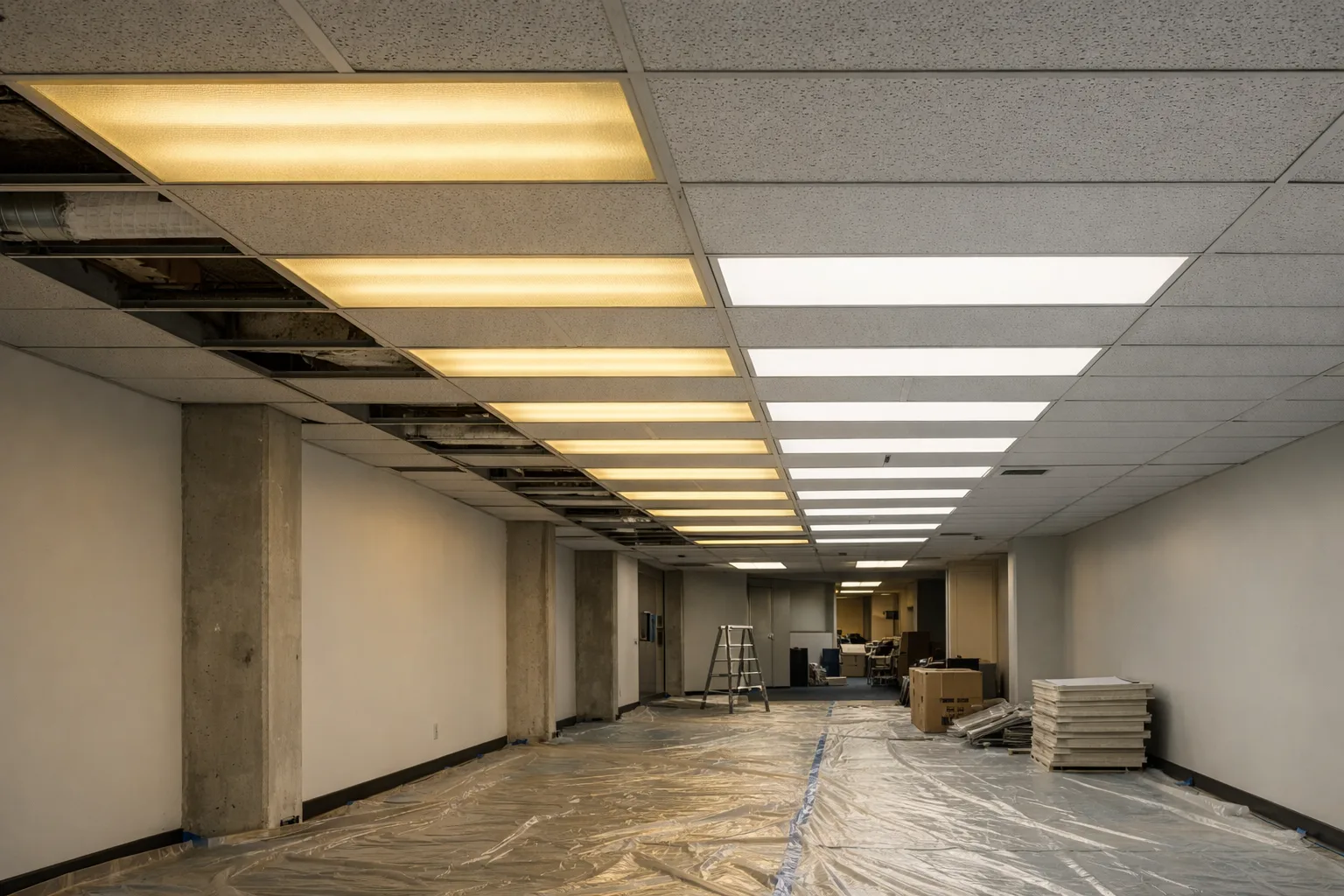
Section
Retrofit & economics
Replacing fluorescent and discharge lighting: what actually changes, what it costs, and how to build a payback case that a finance department will accept.
Wattage equivalence is marketing arithmetic
Almost every retrofit proposal opens with a wattage comparison: a 400 W metal halide high bay replaced by a 150 W LED, therefore a 62% saving. The comparison is not wrong so much as it is answering a question nobody asked. What the client buys is light on a surface, and the number of watts that disappear from the bill has no fixed relationship to whether the racking aisle is still legible at floor level.
Doing it properly means comparing the installation you actually have against the installation you would actually get. That distinction matters most with discharge sources, because a ten-year-old metal halide installation has already lost a large fraction of its output and is quite possibly running with some lamps failed. Comparing against its initial catalogue lumens overstates what the retrofit has to match; comparing against nothing at all understates the improvement the client will perceive on day one. Both errors are common, and they point in opposite directions, which is why two proposals for the same building can differ by a factor of two.
The lines that get left out of a payback case
A payback figure that a finance department will accept has to include the costs that do not appear on the fitting invoice. Access is usually the largest: a high-bay replacement at twelve metres is a scaffold or a MEWP and a shutdown window, and that cost is per visit, which is also why avoided relamping is a real line on the credit side rather than a rounding error. Control gear losses on the outgoing installation belong in the baseline — a magnetic ballast consumes real power that a lamp-wattage comparison silently omits. Where the tariff has a demand or capacity component, the reduction in kVA can be worth more than the kWh saving, and it is the line most often missed entirely.
When the finished job measures low
The most useful thing in this section may be the failure analysis. When a completed retrofit fails its lux survey, the fault is as often in the measurement as in the installation: meter class and cosine correction, warm-up drift on a source that has not stabilised, a reference plane taken at floor level when the specification said 0.8 m, daylight contamination, or a design assumption about surface reflectance that did not survive the client repainting the walls a darker colour.
Working through those in order costs an afternoon. Re-hanging fittings on the assumption that the design was wrong costs considerably more, and in our experience it is the wrong first move about half the time.
 High bay: why "400 W metal halide equals 150 W LED" is not a specificationWhat wattage-equivalence claims leave out, how depreciated HID output makes the comparison unfair in both directions, why vertical illuminance on rack faces matters more than floor lux, and the operational gains that usually exceed the energy saving.
 Lighting power density: the compliance number that decides your retrofit before efficacy doesHow building energy codes cap installed lighting power per square metre, why an efficacy-led product choice can still fail the check, the two ways LPD is assessed and how they differ, control credits, and the calculation to run before the fittings are selected rather than after.
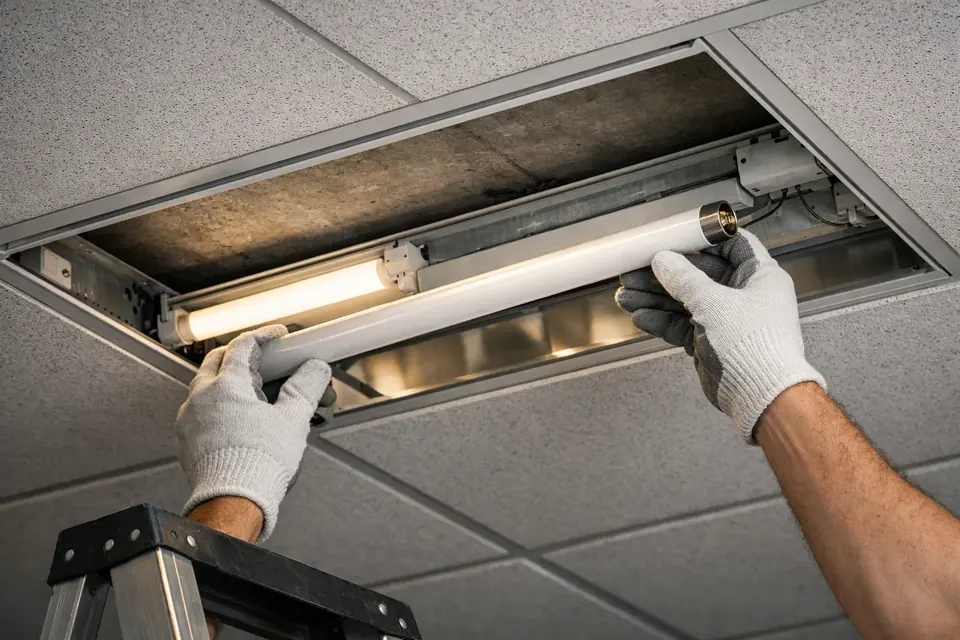 T8 fluorescent to LED: tube swap versus luminaire replacementThe four retrofit routes for a fluorescent installation, what each does to photometry, safety certification and liability, why a lumen-for-lumen tube swap often lands illuminance in the wrong place, and the costs that never appear in the tube price.
 The emergency circuit you inherited: what a lamp swap does to a life safety systemWhy a maintained fitting that still illuminates is not evidence the emergency system survived a retrofit, the four things a T8 conversion changes on an emergency circuit, what the duration test proves and what it does not, and the record that has to exist before the building is handed back.
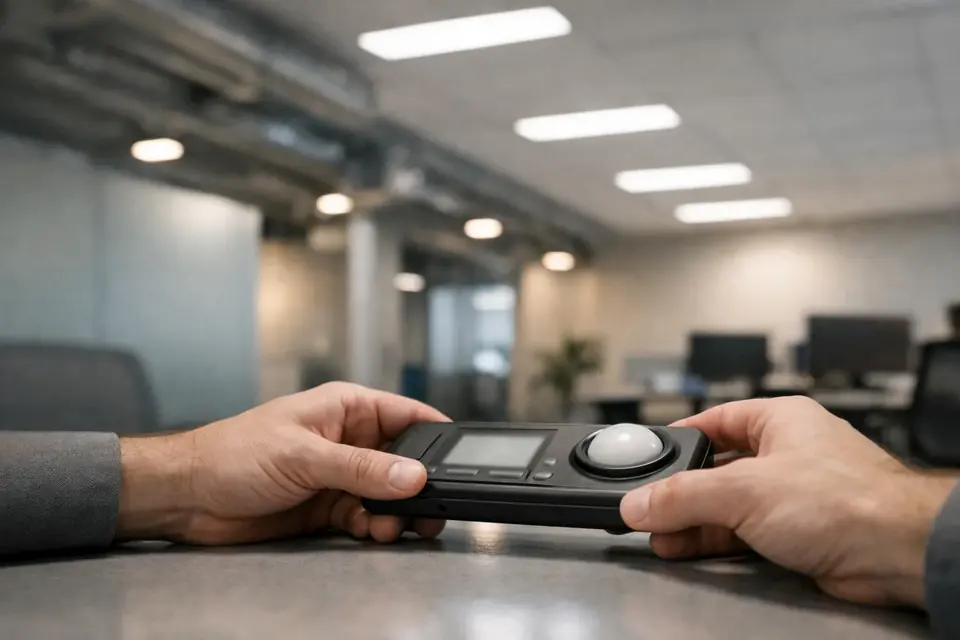 The retrofit measures low: nine causes, in the order worth checkingWhen a completed retrofit fails its lux survey, the fault is as often in the measurement as in the installation. The meter class problem, warm-up drift, reference plane errors, and the design assumptions that quietly did not survive to site.
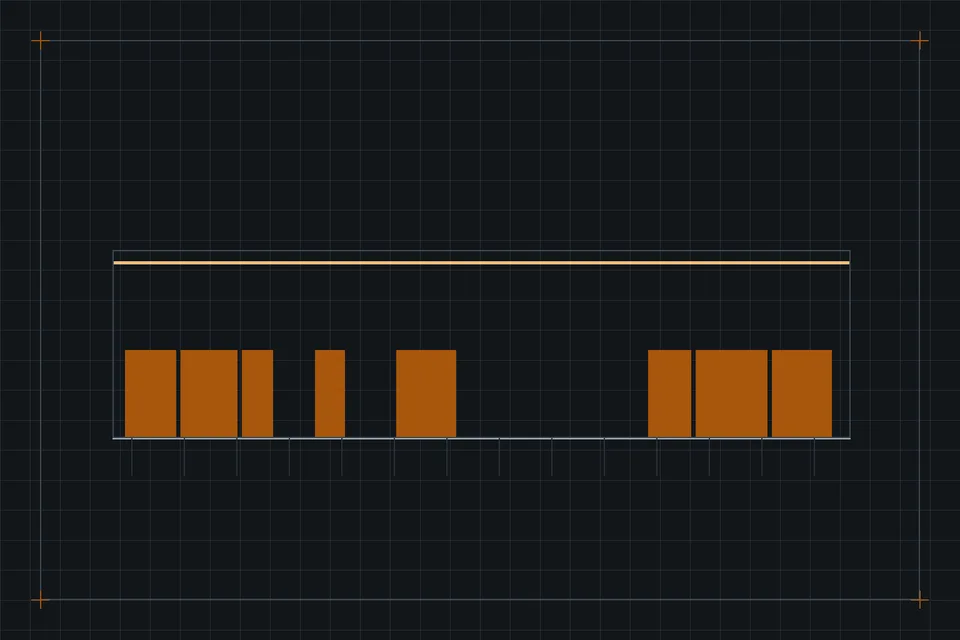 The savings were in the controls, and so was the complaintWhy a controls retrofit routinely delivers a larger saving than the luminaire swap and a larger number of complaints, what false-off actually costs, how to size daylight zones that work, standby power on a large estate, and the commissioning settings that decide whether any of it survives the first month.