Retrofit & economics
T8 fluorescent to LED: tube swap versus luminaire replacement
The four retrofit routes for a fluorescent installation, what each does to photometry, safety certification and liability, why a lumen-for-lumen tube swap often lands illuminance in the wrong place, and the costs that never appear in the tube price.
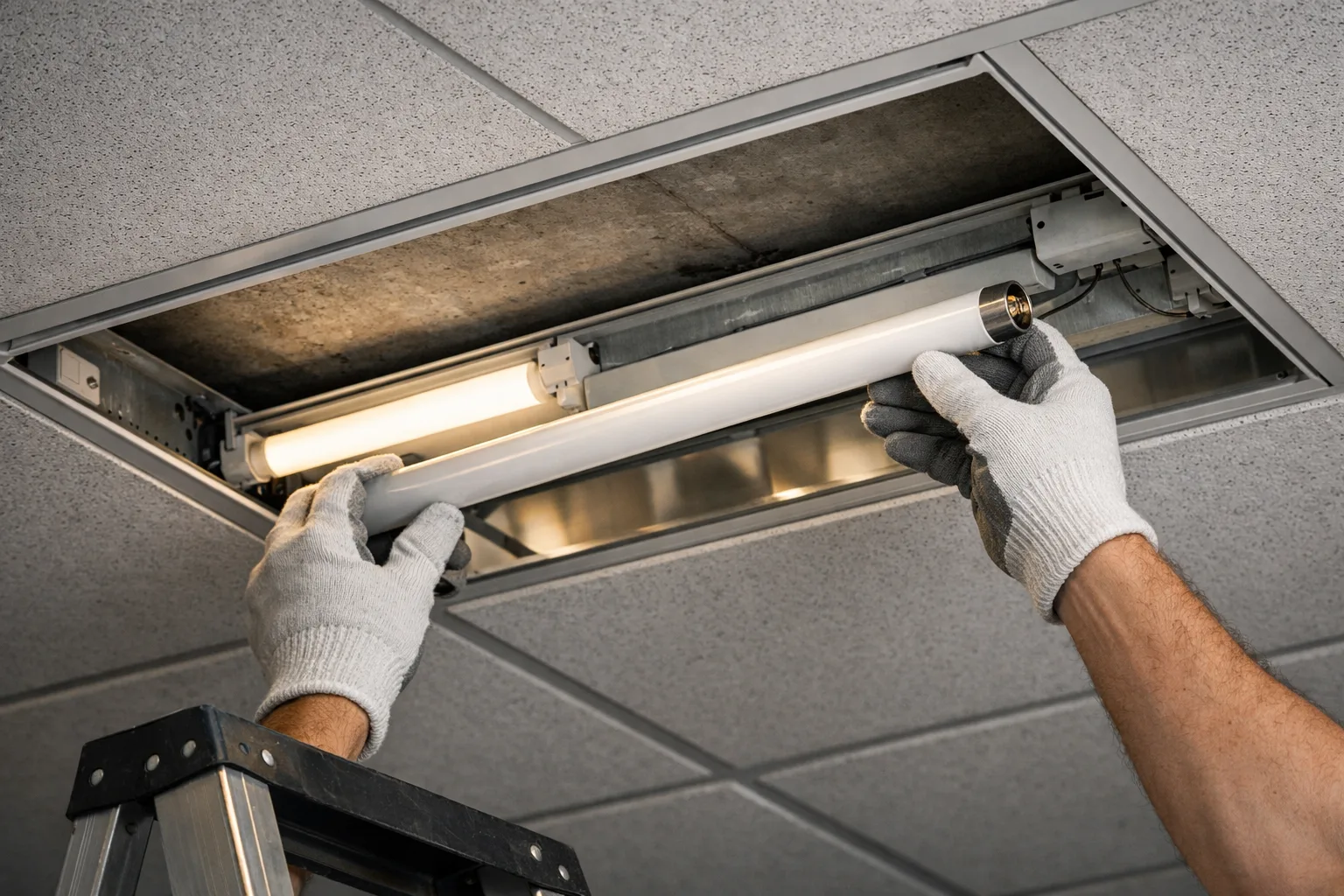
The cheapest option is a tube that drops into the existing fitting. It is also the one that most often produces a room that is measurably compliant and visibly worse, and the one with the least obvious consequences for who is responsible if something goes wrong afterwards.
Four routes, and they are not variations on one thing
| Route | What happens | Photometry | Certification |
|---|---|---|---|
| Ballast-compatible tube | LED tube operates from the existing fluorescent ballast | Reflector and diffuser unchanged; distribution roughly preserved | Tube certified; luminaire's original certification arguably intact |
| Ballast-bypass tube | Ballast removed or bypassed, mains taken to the lampholders; internal rewiring | As above | Luminaire has been modified — see below |
| LED retrofit kit / gear tray | Internals replaced with an LED board and driver; housing retained | New distribution, new photometric file required | Modified luminaire; kit certification does not automatically transfer |
| New luminaire | Whole fitting replaced | Fully specified and calculable | Clean — one manufacturer, one declaration |
The bypass problem, stated plainly
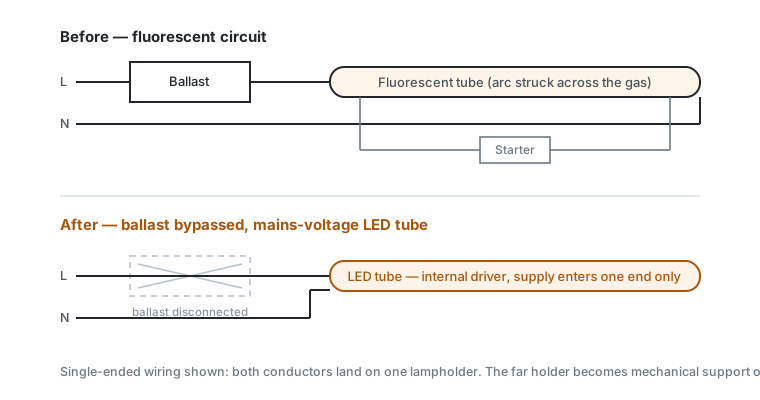
Bypassing the ballast means opening a certified luminaire, removing components, and rewiring it so that mains voltage appears at lampholders that were designed for a ballasted circuit. In most jurisdictions that is a modification, and after it the fitting is no longer the product the original manufacturer declared conformity for.
Practical consequences, in the order they bite:
- Responsibility for the modified fitting moves to whoever modified it.
- The original CE/UKCA/CCC declaration relates to the unmodified product.
- Someone later inserts a fluorescent tube into a lampholder now carrying mains. Double-ended bypass wiring is the dangerous version — this is why single-ended bypass and clear, permanent labelling at the fitting exist, and why the label matters more than it looks.
- Insurers and facilities auditors ask who signed off the modification.
Whether a bypass conversion is acceptable in your jurisdiction, and under what labelling and competence requirements, is a question for the electrical duty holder and the insurer — not for the procurement spreadsheet. Get it answered in writing before the tubes are ordered, not after the first fitting is opened.
Why lumen-for-lumen lands the light in the wrong place
A fluorescent tube emits over essentially the full 360° around its axis. The luminaire's reflector was designed around that: light going upward is collected and redirected downward, and the published photometry is the result of tube plus reflector working together.
Most LED tubes emit into a limited beam angle — commonly around 160–180°, sometimes narrower. Two things follow:
- The reflector is largely out of work. The optical system the luminaire was designed around no longer receives the light it was shaped for.
- Distribution narrows. More flux goes straight down, less to the sides. Directly beneath the fitting illuminance can rise; between fittings and on vertical surfaces it falls.
So a swap that matches lumens can still lose uniformity, darken walls and ceiling, and make a space feel gloomier at an unchanged desk-level average. The occupant complaint — "it's darker since they changed the lights" — is usually accurate about the room even when the meter says otherwise, because they are reacting to the vertical surfaces the note on maintained illuminance covers.
There is a compensating effect: a fluorescent luminaire's light output ratio is typically well below one, because a meaningful share of the tube's output is absorbed inside the fitting before it escapes. A directional LED tube skips some of that loss. Whether the two effects cancel depends entirely on the specific reflector, and the only way to know is a photometric calculation with a photometric file for the tube-in-that-luminaire — which almost nobody obtains, which is why this is guesswork on most projects.
Costs that are not the tube price
Comparisons are usually made on hardware cost, where the tube swap wins by a wide margin. The items below decide the actual outcome and belong in the same table.
| Line | Tube swap | New luminaire |
|---|---|---|
| Hardware per point | Low | High |
| Labour per point | Minutes, unless bypassing | Longer; ceiling work, possibly making good |
| Access equipment | Same for both — often the dominant cost at height | Same |
| Disposal | Fluorescent tubes contain mercury; regulated disposal | Tubes plus fittings |
| Residual life of the housing | Ageing lampholders, sockets, gaskets, diffuser yellowing | Reset to zero |
| Photometric verification | Rarely obtainable | Full file available |
| Controls and dimming | Limited; usually switch-only | DALI, 0–10 V, presence, daylight linking |
| Warranty scope | Tube only; housing is yours | Whole luminaire, one supplier |
| Certification liability | Modified fitting if bypassed | Clean |
Two of these dominate more often than their line items suggest. Access is identical for both routes — if a scissor lift and two people are needed to reach a 9 m high bay, that cost is spent whichever product goes in, and it makes the cheap option much less cheap relatively. And controls are where the energy savings actually are: swapping a tube saves the difference in circuit watts, while a new luminaire with presence detection and daylight linking in a space with reasonable daylight commonly saves several times that. Retrofit business cases built on lamp wattage alone systematically under-value the replacement route.
Where each route is the right answer
- Ballast-compatible tube: short remaining building lease, fittings in good condition, no controls ambition, and the ballast losses accepted. The least disruptive and least committal option.
- Bypass tube: only where the electrical duty holder has accepted the modification in writing, labelling is applied, and the housings have real life left. Cheap up front and it moves liability onto you.
- Retrofit gear tray: good when the housings are architecturally significant or expensive to replace — heritage fittings, custom recessed details — and worth doing only with a photometric file for the finished assembly.
- New luminaire: the default whenever the installation is old enough that housings are near end of life, where controls are wanted, where the lighting design is being reconsidered anyway, or where anyone will later be asked to certify what is on the ceiling.
Run the numbers for your own case with the retrofit payback calculator, and put the access cost in. It is usually the line that decides.
Sources and further reading
- IEC 62776 — double-capped LED lamps designed to retrofit linear fluorescent lamps, including safety requirements around bypass configurations.
- Your national wiring regulations and the requirements applying to modification of certified equipment — BS 7671 in the UK, and the equivalent elsewhere.
- EN 12464-1 — the uniformity and vertical-surface criteria a lumen-for-lumen swap is most likely to fail.
- Waste regulations governing mercury-containing lamp disposal in your jurisdiction.