Metrics & standards
Maintained illuminance is not the number your lux meter reads on handover
Why a room designed to 500 lx should measure well above 500 lx on day one, how the maintenance factor is built from four separate terms, and what goes wrong when a specification quotes a single illuminance number with no reference plane, no uniformity and no MF.
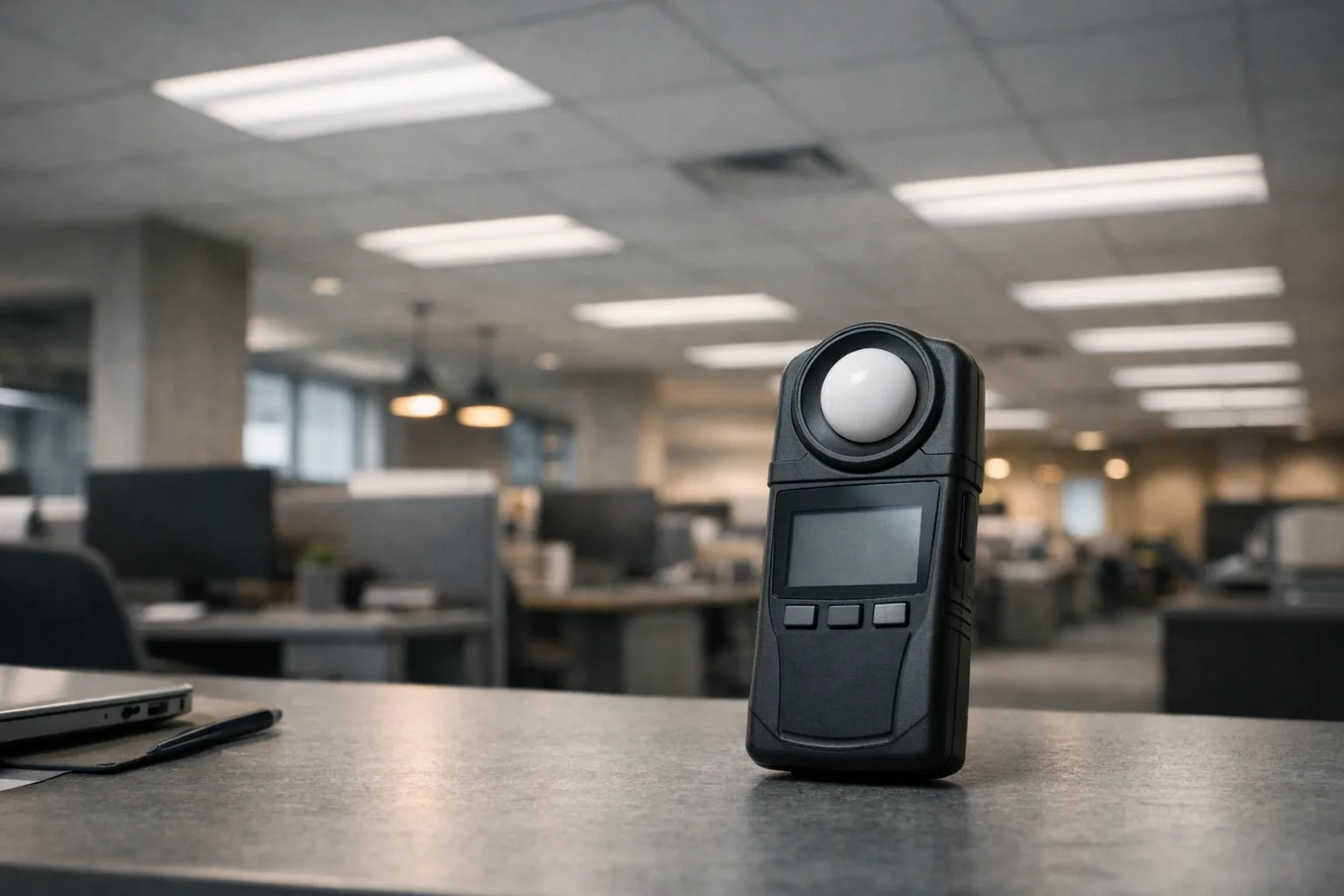
A specification that says "offices: 500 lux" is incomplete in four ways at once, and every one of them shows up later as an argument on site. It does not say where the 500 lx is measured, over what area it is averaged, how uniform it has to be, or whether that number applies on the day of handover or at the end of the maintenance cycle. The standards answer all four. Most tender documents answer none.
The number in the standard is a floor, not a target
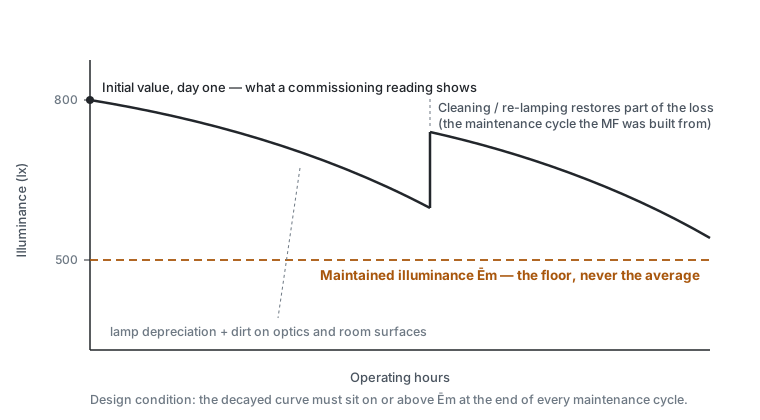
EN 12464-1 — and GB 50034 in the same spirit — specifies maintained illuminance, written Ēm. The definition is the important part: it is the value below which the average illuminance on the specified surface must not fall before maintenance is carried out. It is the worst acceptable state of the installation, at the end of its maintenance interval, with lamps depreciated and luminaires dirty.
That has a direct design consequence. If the task area must never drop below 500 lx, and by end of cycle the installation will have lost, say, a quarter of its output to lumen depreciation and dirt, then the design has to deliver roughly 670 lx when it is new. A commissioning engineer who arrives on handover day, measures 520 lx and signs it off has actually accepted an installation that will be non-compliant within two years. The same arithmetic run backwards is the first thing to check when a finished retrofit measures low.
The reverse error is more common and more expensive: a designer applies a maintenance factor, the client sees the higher initial figure on the calculation sheet, assumes the designer has over-specified, and asks for luminaires to be removed to save money.
The maintenance factor has four terms and people use one
MF is routinely quoted as a single habitual number — 0.8 shows up on an enormous number of drawings. It is a product of four independent factors, and for LED installations two of them behave differently than they did for fluorescent.
| Term | Name | Governed by | Question to ask |
|---|---|---|---|
| LLMF | Lamp lumen maintenance factor | LED package and thermal design; declared as an L-value (L80, L90) at a stated number of hours and a stated case temperature | At what Tc was the L-value declared, and does the fitting run at that temperature in this ceiling? |
| LSF | Lamp survival factor | The B-value paired with the L-value — B10 means 10% of units are expected to be below the L threshold at that hour count | Is the quoted figure L80B10 or L80B50? They are not interchangeable. |
| LMF | Luminaire maintenance factor | Ingress rating, optic type, cleaning interval, how dirty the air is | Who is cleaning these, and how often, and can they reach them? |
| RSMF | Room surface maintenance factor | Reflectance decay of ceiling, walls and floor; matters most in indirect and semi-indirect schemes | Is the scheme direct or indirect? For heavily indirect lighting this term dominates. |
The trap specific to LED is LMF, not LLMF. LED lumen depreciation is slow and well-characterised, so LLMF is often 0.95 or better over a realistic interval. That tempts people into a high overall MF. But an LED luminaire with an exposed diffuser in a workshop collects dirt exactly as fast as the fluorescent fitting it replaced, and if nobody has been assigned to clean it — which, on a maintenance-free-marketed LED retrofit, is common — LMF is doing more damage than lamp depreciation ever will.
When an MF of 0.9 or higher appears on a calculation, it is almost always a default that was never justified. Ask which cleaning interval it assumes. If the answer is "they don't need cleaning", the number is wrong.
Where the measurement is taken
Illuminance requirements attach to a task area, not to a room and not to the floor. The task area is where the visual work happens: the desk surface, the machine bed, the shelf face. Around it, the standard defines an immediate surrounding area — a band of roughly half a metre — with a lower requirement, and beyond that a background area lower still. The stepped structure exists to stop designers producing uniformly bright boxes.
Two practical consequences:
- The reference plane must be stated. Desk work is normally taken at 0.75 m above floor; circulation at floor level. Measuring a 500 lx office at floor level and reporting a fail is a measurement error, not a design fault. This is the single most common source of a disputed handover reading.
- If the furniture layout is unknown, the whole area becomes task area. Speculative office fit-outs are the usual case. That is a significantly more demanding requirement than lighting known desk positions, and it is worth making explicit in the brief rather than discovering it at tender.
Uniformity is a separate requirement, and it fails independently
Uniformity U0 is defined as Emin ÷ Eavg over the relevant area. A scheme can hit its average illuminance target while failing uniformity badly — this is exactly what happens when someone reduces luminaire count and increases output per fitting to save money. The average survives. The pattern of bright pools and dim gaps does not, and the room reads as badly lit even though the meter says it is compliant on average.
When you receive a lighting calculation, U0 should be on it for each area type. If it is missing, the calculation has been run for average illuminance only and the layout has not really been checked.
The 2021 revision added surfaces people forget
EN 12464-1:2021 made explicit what good practice already did: walls and ceilings carry their own maintained illuminance recommendations, and there is a cylindrical illuminance requirement for spaces where the appearance of people matters — meeting rooms, receptions, anywhere faces are the subject.
This matters for procurement because it defeats the cheapest possible compliance strategy. A grid of narrow-beam downlights can meet a horizontal task-plane target while leaving walls and ceiling dark, which produces a gloomy room that passes its horizontal test. The wall, ceiling and cylindrical criteria exist to catch that. If a proposal meets the desk figure and says nothing about vertical surfaces, it has answered one third of the standard.
We deliberately do not reproduce the illuminance tables here. They are licensed content, they are revised — EN 12464-1 changed materially in 2021 — and a value transcribed into a web page is a value nobody maintains. Buy the current edition, or use the version your project's jurisdiction actually mandates. If a website quotes you a task illuminance table without an edition date, you have no idea which revision you are complying with.
What a complete illuminance line looks like
A specification line that will not be argued about later carries five things, not one:
| Parameter | Stated as | Why it has to be there |
|---|---|---|
| Maintained illuminance | Ēm on task area | Distinguishes end-of-cycle floor from day-one reading |
| Reference plane | 0.75 m AFFL | Removes the commonest measurement dispute |
| Uniformity | U0 minimum | Prevents average-only compliance with bright pools |
| Maintenance factor | MF with its four terms and cleaning interval | Makes the initial design figure auditable |
| Glare limit | UGRL for the viewing directions | See the note on why a catalogue UGR figure often does not apply |
If you write those five lines into a brief, the returned calculations become comparable between tenderers, which is the actual point. Two proposals quoting "500 lux" can differ by 30% in installed load and neither is wrong, because they assumed different maintenance factors.
Sources and further reading
- EN 12464-1, Light and lighting — Lighting of work places, Part 1: Indoor work places — task/surrounding/background area structure, maintained illuminance definition, uniformity, and the 2021 additions on wall, ceiling and cylindrical illuminance. Purchase from your national standards body.
- GB 50034 建筑照明设计标准 — the governing illuminance and lighting power density standard for projects in mainland China.
- CIE 97, Guide on the maintenance of indoor electric lighting systems — the source of the four-term maintenance factor structure.
- IEC 62717 — LED module performance requirements, including how L and B values are declared. Read alongside IES LM-80 and TM-21, covered separately in our note on lumen maintenance.