Selection & calculation
What a "50,000 hour" LED claim is allowed to mean
How LM-80 measurement and TM-21 extrapolation actually produce a lifetime figure, the 6× rule that caps how far a claim may be projected, why the number describes an LED package rather than a luminaire, and the component that usually fails first anyway.
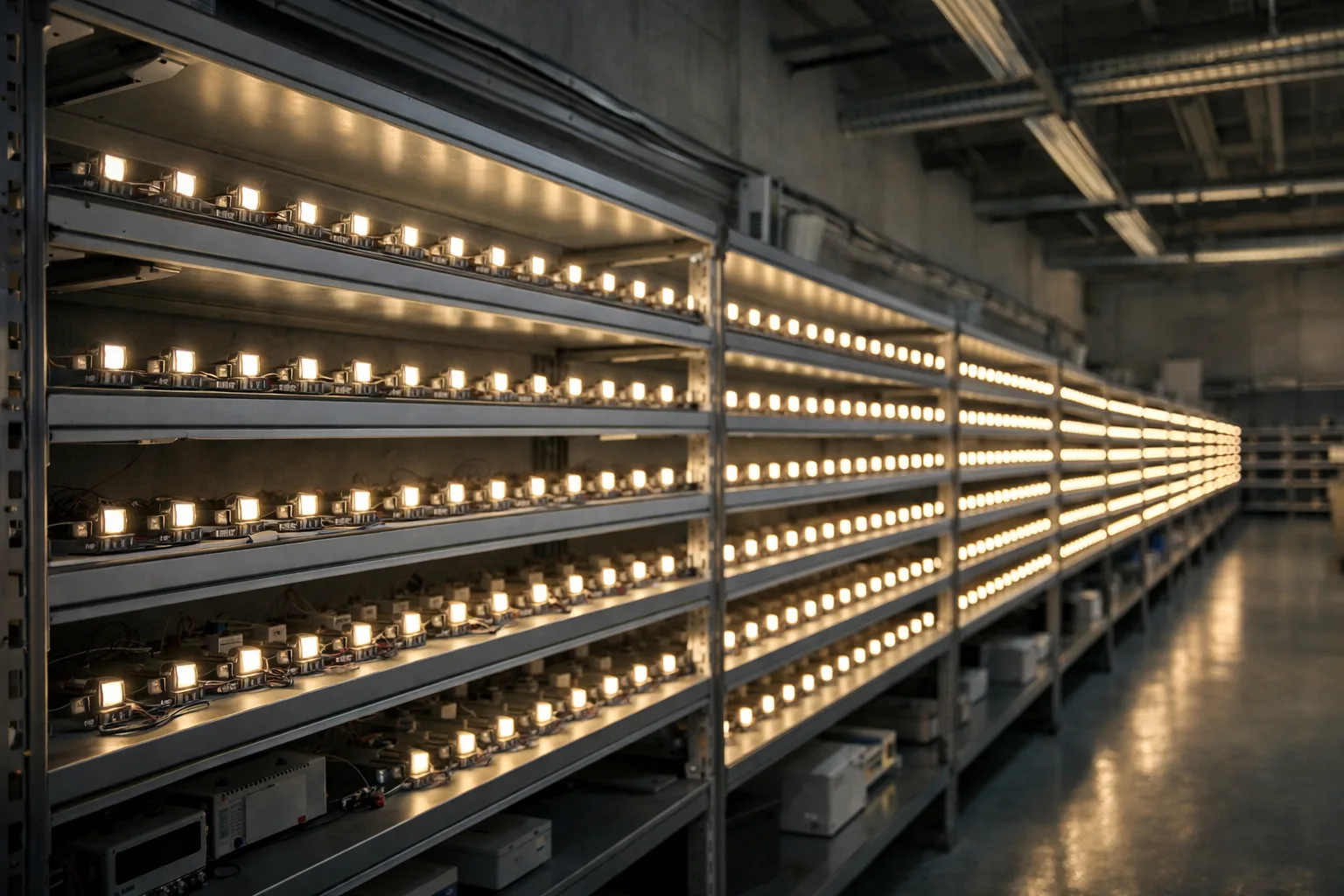
Nobody tests a light fitting for fifty thousand hours. That is five and a half years of continuous operation, several product generations. The figure on the datasheet is an extrapolation from a much shorter measurement, governed by a published method with explicit limits — and those limits are the interesting part, because a large share of lifetime claims in the market exceed what the method permits.
Two documents, doing two different jobs
| IES LM-80 | IES TM-21 | |
|---|---|---|
| Is | A measurement method | A projection method |
| Applies to | LED packages, arrays and modules | The data LM-80 produced |
| Produces | Measured lumen and chromaticity maintenance at set case temperatures and drive currents | A projected hour count at which output falls to a stated fraction |
| Duration | Minimum 6,000 h; 10,000 h is the usual commercial data set | N/A |
| Does not cover | Drivers, optics, housings, the finished luminaire | Anything LM-80 did not measure |
Reading L and B together
Lifetime is stated as a pair. L is the fraction of initial output remaining: L70 means 70% remaining, L80 means 80%. B is the proportion of units that have fallen below that threshold: B10 means 10% of them, B50 means half.
So "L80B10 at 50,000 h" says: at 50,000 hours, 90% of units still deliver at least 80% of their initial output. And "L70B50 at 50,000 h" says: at 50,000 hours, half the units are below 70%. Both are "50,000 hour" claims. They describe quite different products.
The same pair of numbers governs what a performance warranty is actually worth, which is why the B value belongs in the contract as well as on the datasheet — see reading LED warranty terms.
"Is that L70B50 or L80B10?" A supplier quoting a bare hour count without the L and B values has given you a number with no content. If the B value is missing it is very often B50.
The 6× rule, which is where most claims break
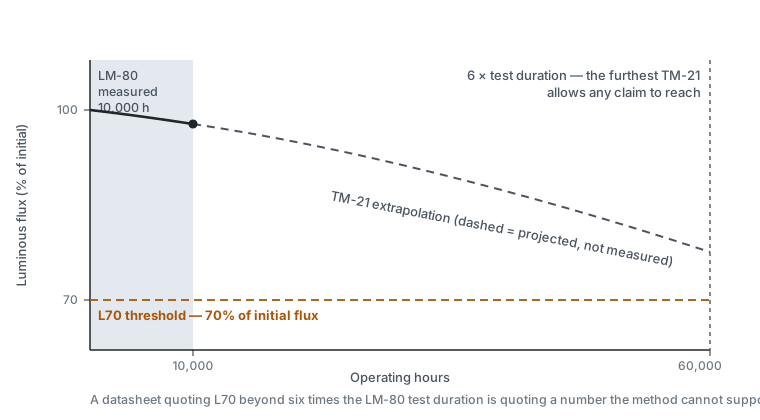
TM-21 does not permit unlimited extrapolation. The projection may be reported out to a multiple of the measured test duration — six times the test time where the data set has enough units, and less where it does not. Beyond that multiple, the method requires the claim be reported as "greater than" the limit rather than as a specific number.
The consequence is immediate and checkable. A product whose LM-80 data runs to 10,000 hours cannot legitimately be reported as a specific 100,000-hour L70 figure. The correct statement is "L70 > 60,000 h". When you see a precise six-figure lifetime, ask for the LM-80 report and its duration — the arithmetic either works or it does not, and it takes thirty seconds.
Package data is not luminaire data
LM-80 measures the LED package at a controlled case temperature. Your luminaire's LEDs run at whatever temperature its thermal design produces, in the ceiling void it is actually installed in.
Bridging that gap is a real procedure, not an assumption. The manufacturer measures the in-situ temperature at the specified point on the board in the finished luminaire under the worst-case installation condition, then interpolates the LM-80 data set at that temperature. That is the number that describes your fitting.
Two ways it goes wrong:
- Quoting the package figure directly. The LED maker's datasheet says L70 at 85 °C case temperature; the luminaire runs its LEDs hotter; the claim is transplanted anyway.
- Testing in free air. A downlight measured on a bench in open air and then installed in an insulated ceiling runs far hotter than tested. Where insulation contact is possible, the rating and the thermal test have to reflect it.
Lumen maintenance is not failure
An L70 point is not the moment the fitting stops working. It is when output has degraded to 70% — gradual, mostly imperceptible day to day, and normally significant only because the installation was designed with a maintenance factor that assumed a particular depreciation.
What actually takes fittings out of service is abrupt failure, and that is usually the driver. Electrolytic capacitor life halves for roughly every 10 °C rise, and a driver in a hot ceiling void can fall well short of the LED's projected lumen maintenance. See driver matching for the temperature relationship and what to ask about Tc.
Which produces the practical rule: when a supplier quotes a luminaire lifetime, ask which component it describes. If the answer is the LED, ask separately for the driver's rated life at its actual case temperature. The smaller of the two is the fitting's service interval, and it is rarely the LED.
Colour maintenance is in the same report and rarely read
LM-80 measures chromaticity shift alongside lumen maintenance. For any installation where fittings share a visual field, that data matters as much as the lumen figure — a row that starts matched and drifts apart is more visible than one that dims evenly. Specify it as a Δu′v′ limit at a stated hour count; see colour consistency and SDCM.
What to request, and what to check on receipt
- The LM-80 report for the package used, with its test duration and the case temperatures tested.
- The TM-21 projection with L and B values, and the projection checked against the 6× limit for that test duration.
- The in-situ temperature measurement for the finished luminaire in the worst-case mounting condition, and confirmation that the interpolation used that temperature.
- The driver's rated life, separately, with the Tc point and temperature it is quoted at.
- Chromaticity maintenance as a Δu′v′ limit where colour matters.
Requesting five documents sounds heavy for a lighting order. In practice it is one email, and the response separates suppliers who have the data from suppliers who have a marketing figure faster than any other question you can ask.
Sources and further reading
- IES LM-80, Measuring Luminous Flux and Color Maintenance of LED Packages, Arrays and Modules.
- IES TM-21, Projecting Long Term Lumen, Photon, and Radiant Flux Maintenance of LED Light Sources — the projection method and its reportable limit.
- IES LM-79, Approved Method: Optical and Electrical Measurements of Solid-State Lighting Products — absolute photometry of the finished luminaire, the complement to package-level LM-80.
- IEC 62717 — LED module performance requirements, including declaration of L and B values.