Acceptance & QC
Colour consistency: why same-batch fittings still do not match
What an SDCM step actually bounds, why an ANSI chromaticity bin is not the same thing, the four stages between LED binning and installed colour where consistency is lost, and a wall test that settles an argument in twenty minutes.
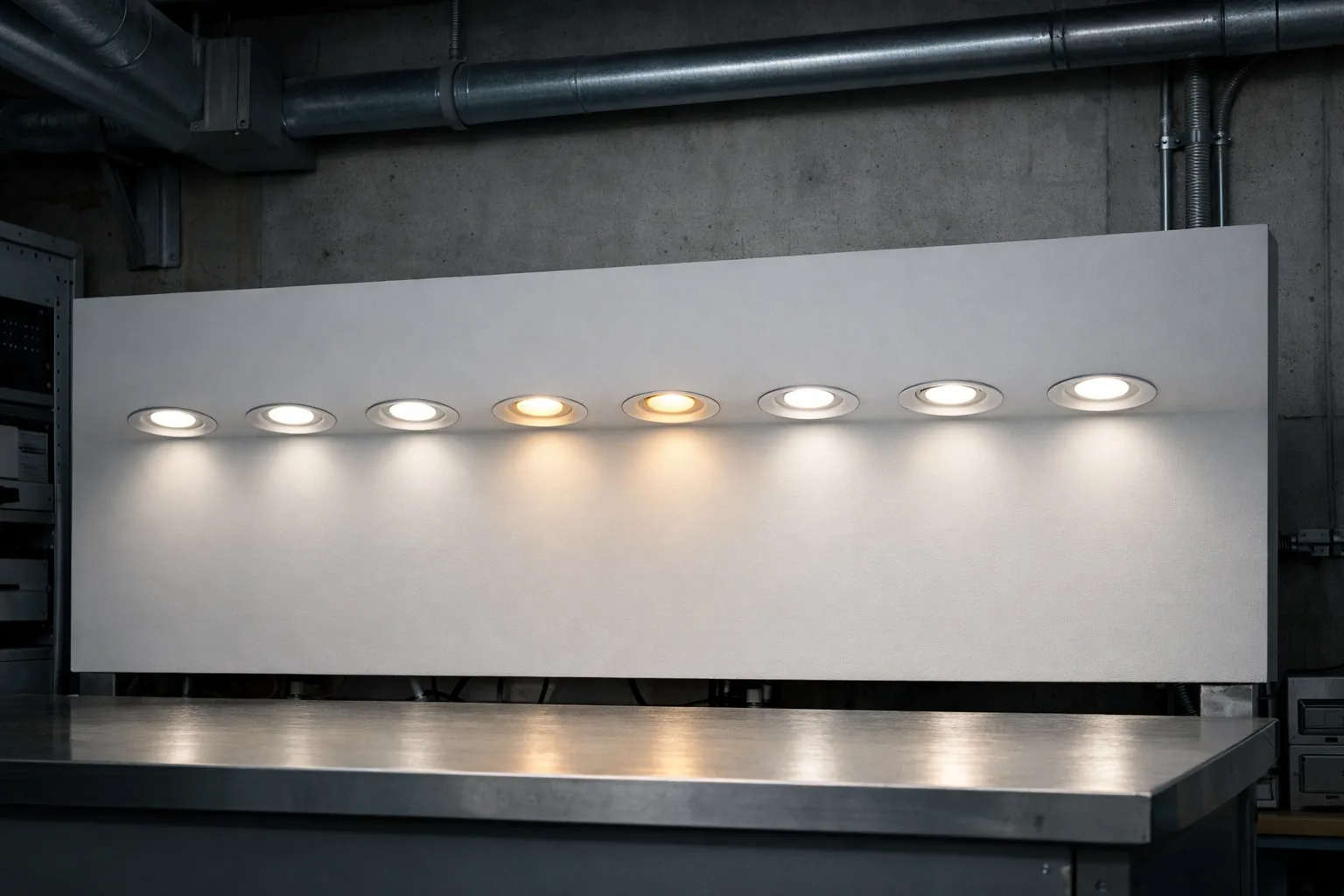
A row of downlights where one is visibly pinker than its neighbours is the most reliably noticed lighting defect there is. Nobody notices 480 lx instead of 500. Everybody notices one light that is the wrong colour, and once seen it cannot be unseen.
SDCM, in one paragraph
Colour differences are quantified using MacAdam ellipses: regions of the chromaticity diagram inside which a standard observer cannot distinguish colours from the one at the centre. One step — 1 SDCM — is roughly the threshold of perceptibility under ideal side-by-side viewing. Larger steps are proportionally larger ellipses.
| Step | Perception | Where it belongs |
|---|---|---|
| 1–2 | Not distinguishable, or only by a trained observer | Museum, high-end retail, anywhere fittings are adjacent in one visual field |
| 3 | Difference visible to a careful observer in direct comparison | The usual commercial specification for offices and general interiors |
| 5 | Visible to most people when fittings are adjacent | Common for inexpensive product; acceptable only where fittings are well separated |
| 7+ | Obvious | Nowhere in a specified installation |
An ANSI bin is not an SDCM ellipse
Both are ways of drawing a boundary around "acceptable white", and the geometry that makes them incompatible — a bin is a quadrangle around a nominal CCT, an ellipse is a perceptual contour around a target chromaticity — is worked through in CCT, Duv and the black-body locus.
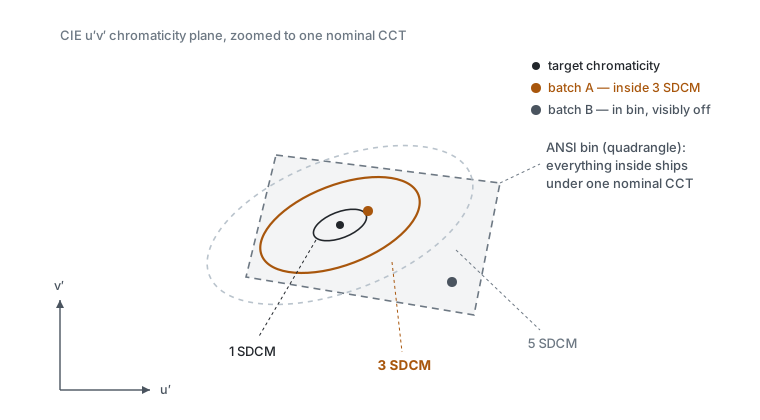
This substitution is common and it matters. ANSI C78.377 defines nominal CCT categories as quadrangles on the chromaticity diagram. A MacAdam ellipse is an ellipse. They are different shapes, and a quadrangle bin is wider than a 3-step ellipse in some directions.
So "4000 K, ANSI bin" and "4000 K within 3 SDCM" are not equivalent claims, and a supplier can satisfy the first while shipping product that visibly fails the second. If colour consistency matters, specify the SDCM step explicitly rather than relying on a nominal CCT.
Where consistency is actually lost
Tight LED binning is necessary and nowhere near sufficient. Four stages sit between a binned package and the light on the wall, and each one can undo the previous.
- Package binning. The manufacturer's bin structure — how many bins, what shape, which ones you were actually shipped. Buying "a 3-step product" means nothing if the assembler mixed adjacent bins in one batch.
- Phosphor and optical layers. Remote phosphor, diffusers and tinted covers all shift chromaticity, and their own manufacturing tolerance adds to the package tolerance rather than replacing it.
- Drive current. Chromaticity moves with current. Two fittings with drivers at opposite ends of their tolerance run at slightly different currents and therefore at slightly different colour points.
- Junction temperature. Colour shifts as the fitting warms up and settles at its operating temperature. A recessed fitting in an insulated ceiling and the same fitting in open air reach different equilibria — and therefore different colours.
The SDCM figure that matters is the one for the finished luminaire at its operating temperature, not the LED package datasheet. Ask which one is being quoted. In our experience the package figure is what gets offered, because it is the better number.
Colour shift over life is a separate specification
Initial consistency does not guarantee they stay together. Chromaticity drifts as phosphor and encapsulant age, and it drifts at a rate that depends on operating temperature — so fittings in hotter positions drift faster and the installation diverges over time.
This is specified as a maximum colour shift over a stated period, usually as a Δu′v′ limit. LM-80 test reports include chromaticity shift data alongside lumen maintenance; it is generally the less-read half of the report. If a project is maintaining a coherent visual field for years — retail chains and hospitality especially — the colour maintenance limit belongs in the specification next to the lumen maintenance one.
A wall test that settles the argument
Whether a delivered batch is acceptable is answered in twenty minutes, without instruments, and the procedure matters because doing it carelessly produces false results in both directions.
- Take a sample across the delivery — different cartons, different pallet positions. Sampling one carton tests one carton.
- Mount them adjacent, aimed at a matt white or neutral grey surface, with overlapping pools of light. Adjacency is essential: the human eye is exquisitely sensitive to a boundary between two whites and nearly blind to the same difference separated by a metre of wall.
- Run them on the same driver type at the same setting, from the same supply.
- Wait for thermal equilibrium — at least 30 minutes. Cold fittings can match and then diverge as they warm, which is the most common way this test is got wrong.
- View from the working position at the working distance, under the ambient conditions of the space. Judging from a metre away in a dark room is a harsher test than the installation will ever face.
- Photograph it with a fixed manual white balance if there is any chance of a dispute. Auto white balance will normalise exactly the difference you are trying to record.
If a visible difference survives that, it will be visible in the building. The test does not produce a number, and it does not need to — the question at acceptance is binary.
Escalating from the wall test to a measurement
The wall test settles most arguments because most colour disputes are about something plainly visible. When it does not — the difference is marginal, the value at stake is large, or the supplier disputes the observation — the next step is an instrumented measurement, and it is worth knowing what to ask for so the report answers the question you actually have.
Specify the measurement in these terms:
- u′v′ coordinates, not CCT. Two fittings can share a nominal 4000 K and sit far apart on the green–magenta axis. The quantity that predicts a visible difference is the distance between chromaticity coordinates, so ask for u′v′ (or x,y with the Δu′v′ computed) for every unit measured.
- At thermal equilibrium, in the finished luminaire. Chromaticity moves while a fitting warms up. A measurement taken two minutes after switch-on describes a state the building will never be in. Thirty minutes to steady state, in the intended mounting orientation, is the condition that matters.
- A stated sample size, drawn across the delivery. Five units from one carton characterise one carton. For a batch acceptance the sample has to be drawn across cartons and, if the delivery spans production dates, across those too — ISO 2859-1 gives defensible sample sizes by lot size if you would rather not invent one.
- The instrument named, with its calibration date. A calibrated spectroradiometer and a cheap colorimeter can disagree by more than the tolerance under dispute. If the number will be used to reject a delivery, the instrument class belongs in the report.
Write the acceptance criterion as a maximum Δu′v′ between any two units in the sample, not as an SDCM step. SDCM steps are defined around a target chromaticity; what a client sees on a wall is the spread within the delivery, and those are not the same quantity. A supplier can meet a 3-step SDCM claim against nominal while the extremes of your delivery sit six steps apart from each other.
Specification lines that work
- SDCM step for the finished luminaire at operating temperature, not the LED package.
- A Duv limit as well as CCT — see the note on CRI and TM-30 for why nominal CCT alone lets a green- or pink-tinted product through.
- Colour maintenance over life as a Δu′v′ limit at a stated hour count.
- Single production batch for any one visual field, with spares from the same batch reserved at the time of order. This is the cheapest clause in the document and prevents the failure mode where a replacement fitting two years later cannot be matched at any price.
Sources and further reading
- MacAdam, D. L. (1942), Visual sensitivities to color differences in daylight — the origin of the ellipses that SDCM steps scale.
- ANSI C78.377 — chromaticity specification for SSL products; the quadrangle bins and their relationship to nominal CCT.
- IES LM-80 — measurement of lumen and chromaticity maintenance of LED packages, arrays and modules.
- IEC 60081 / IEC 62717 — chromaticity tolerance conventions for lamps and LED modules.