Metrics & standards
Two 4000 K products that do not match: CCT, Duv and the black-body locus
Why correlated colour temperature alone never pinned down a white, what Duv measures, how much of it the eye sees, and the two lines in a specification that stop a green-tinted delivery from being technically compliant.
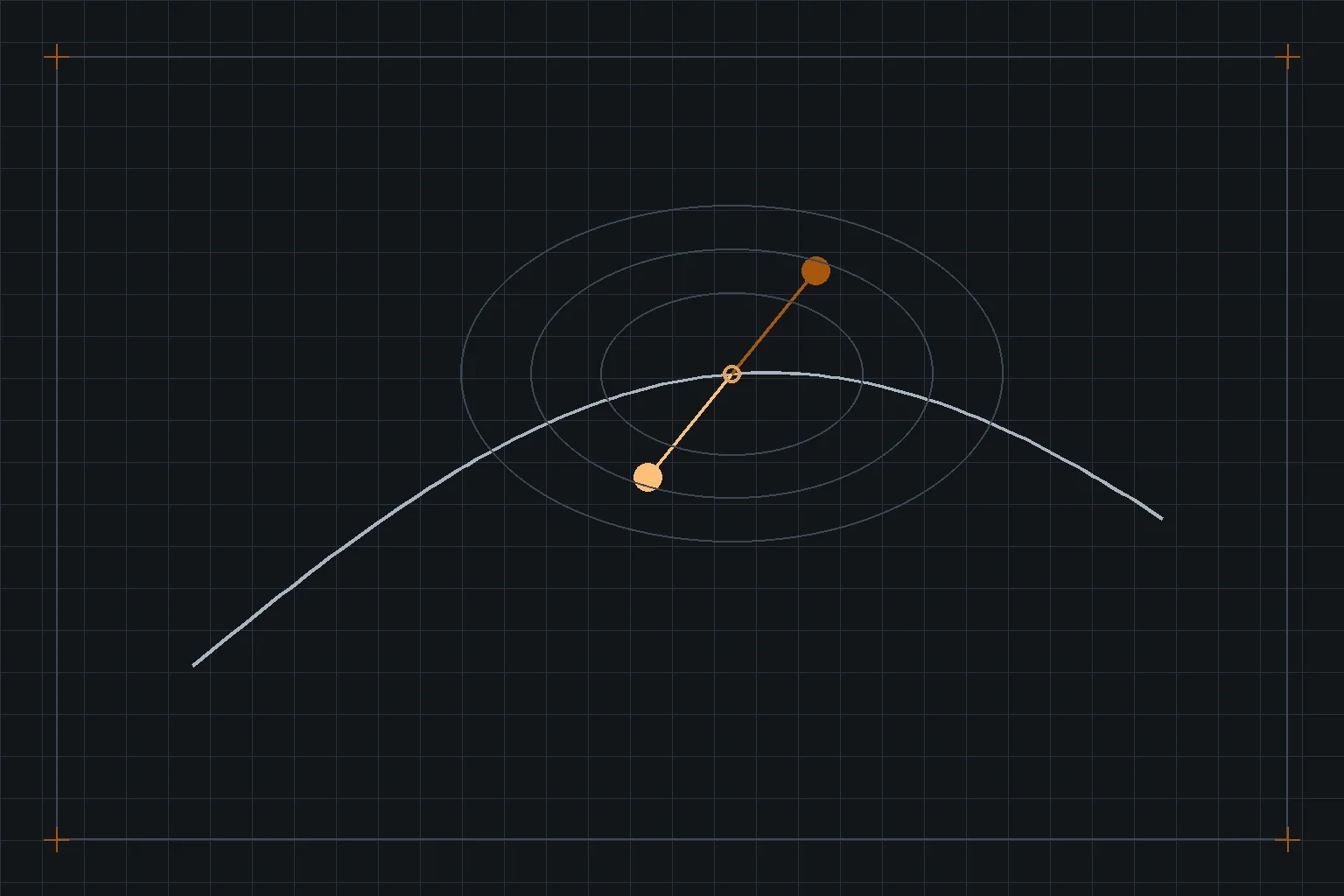
The complaint arrives in the same form every time. Two fittings, both sold as 4000 K, both with a test report, and on the wall one of them is visibly greener than the other. Nobody has done anything wrong on paper, which is the frustrating part — correlated colour temperature is doing exactly what it was defined to do, and what it was defined to do is not what the specification assumed.
CCT is a projection, and projections lose a dimension
A white light source has a chromaticity: two numbers, a point on a plane. CCT collapses those two numbers into one by finding the point on the Planckian locus — the curve traced by a black body as its temperature rises — that lies closest to the source, and reporting that black body's temperature. It is a nearest- neighbour lookup, and like every projection it throws away the direction of the error.
The consequence is geometric and unavoidable. Every chromaticity on the line running perpendicular to the locus through a given point maps to the same CCT. A source sitting well above the locus and a source sitting well below it are both "4000 K", and above the locus is green while below it is pink. Two products can carry the same nominal figure, both truthfully, and differ in the one direction the eye is most sensitive to.
Duv is the missing coordinate
Duv restores it. It is the signed distance from the source's chromaticity to the Planckian locus, measured in the CIE 1960 uv diagram, where the distance is defined so that positive means above the locus (green) and negative means below (pink or magenta). Report CCT and Duv together and the chromaticity is fully specified; report CCT alone and it is not.
The arithmetic is short enough to do from any test report that gives CIE 1931 x,y or CIE 1976 u′,v′. The 1960 coordinates come straight from either:
u = 4x / (−2x + 12y + 3)
v = 6y / (−2x + 12y + 3)
Or from the 1976 diagram directly: u = u′, and v = 2⁄3 v′.
Duv is then the distance from (u, v) to the nearest point on the locus, signed by which side of it you are on. Every spectroradiometer's software reports the value directly, and any manufacturer whose report gives x,y but not Duv is one email away from giving you both. The definitions live in CIE 15 and in ANSI C78.377; the practical calculation is set out in Ohno's 2014 paper, which is the reference most instrument vendors implement.
How much of it does the eye actually see
Roughly: a Duv difference of about 0.003 between two surfaces lit side by side is where most people start to notice a tint difference, and 0.006 is obvious to anyone asked to look. That number is not a threshold in any standard — it is a working figure from comparing deliveries — but it is close enough to be useful, and it explains why so many disputes are technically unwinnable.
ANSI C78.377 defines the nominal CCT bins as quadrangles on the chromaticity diagram, and those quadrangles are wide. Their Duv tolerance is around ±0.006 at the common nominal temperatures. So two products can both sit inside the same C78.377 quadrangle, both be entitled to the 4000 K label, and be separated by more than twice the distance at which a client will see a difference. There is nothing wrong with the bin; it was drawn to a different purpose. It is simply too coarse to be used as a matching criterion, and it is routinely used as one.
A C78.377 quadrangle and an SDCM ellipse are different objects with different shapes and different jobs, and a supplier quoting "3-step SDCM" and a supplier quoting "C78.377 4000 K" are not making comparable claims. The distinction, and what to write instead, is covered in colour consistency and SDCM.
Where the tint comes from
A phosphor-converted white LED is a blue pump behind a phosphor layer. What reaches the eye is the pump light that got through plus the light the phosphor re-emitted, and the ratio between them is set by how much phosphor is in the path. Layer thickness, phosphor loading and geometry all vary across a production run, and moving that ratio moves the chromaticity along a track that crosses the locus rather than following it. That is why a batch scatters in Duv rather than in CCT, and why sorting product by CCT bin alone does not clean up a delivery.
Two further sources of drift matter on site. Chromaticity moves as a fitting warms up, so a measurement taken before thermal equilibrium describes a state the building never occupies. And on a dimmable product, chromaticity commonly moves with drive current — modestly on a well-designed constant-current driver, considerably on cheap PWM at low duty. A specification that fixes colour at full output and says nothing about the dimmed condition has fixed the easy case.
What to require, in two lines
Almost every colour dispute we have been asked to arbitrate would have been prevented by these:
- Nominal CCT with a Duv limit for the finished luminaire at thermal equilibrium. A Duv window of ±0.003 around the target is achievable from any competent manufacturer and is tight enough to be invisible. Say "finished luminaire", because a package-level figure does not survive the optic and the thermal path.
- A maximum Δu′v′ between any two units in the delivery. This is the clause that governs what a client sees, because a client compares fittings with each other and not with a target on a chart. Both units can sit inside your Duv window at opposite edges of it; the spread clause is what closes that gap.
Add the dimming condition if the installation dims: the same limits at 100 %, 50 % and 10 % output. And ask for the evidence as measured chromaticity coordinates rather than a declared bin — an LM-79 report for the actual product contains them, and a catalogue page does not.
What CCT and Duv still do not tell you
Both are chromaticity quantities: they describe the colour of the light, not what it does to the colour of objects. Two sources can share a CCT and a Duv and render a red fabric completely differently, because rendition depends on the shape of the whole spectrum and chromaticity depends only on where it integrates to. That is a separate specification with separate metrics, and it is covered in CRI (Ra) versus TM-30. Specifying one without the other leaves half the problem open.
Sources and further reading
- ANSI C78.377 — chromaticity specification for solid-state lighting products; the nominal CCT quadrangles and the Duv tolerance attached to each.
- CIE 15, Colorimetry — the definition of the chromaticity diagrams and of correlated colour temperature.
- Ohno, Y. (2014), "Practical Use and Calculation of CCT and Duv", LEUKOS 10(1) — the calculation method implemented by most instrument software.
- IES LM-79 — the absolute photometric measurement that produces chromaticity coordinates for the finished luminaire rather than the package.