Metrics & standards
220 lm/W on the package, 130 lm/W on the ceiling: where luminaire efficacy goes
How a package efficacy figure becomes a luminaire efficacy figure, every derating step between them with a worked example, the four ways the number gets inflated on a datasheet, and why the highest efficacy on a tender is often the wrong fitting to buy.
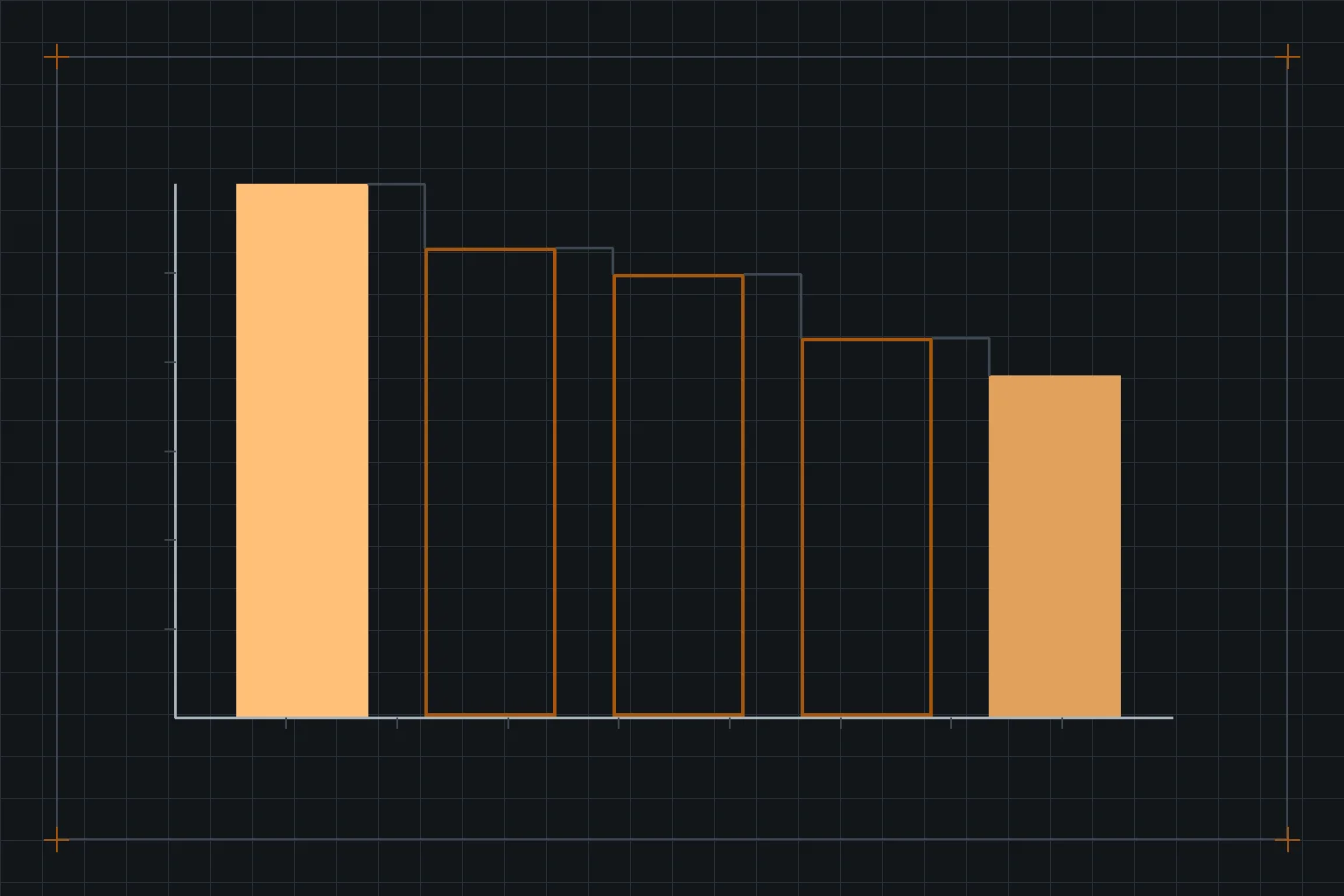
Efficacy is the easiest number on a tender to compare and one of the easiest to misread. Two suppliers quote 220 lm/W and 150 lm/W; the second is dearer; the decision looks like it makes itself. Then the installed result is that both schemes draw about the same power, because the two figures were measured at different points in the same chain and only one of them describes a product you can buy.
Four numbers wearing the same unit
Lumens per watt is quoted at four places in an LED luminaire, and the gap between the first and the last is routinely a third of the value.
- Package efficacy. A bare emitter on a test board, held at a defined case temperature, driven at a defined current. This is the number in the LED manufacturer's binning table and it is the largest of the four.
- Module efficacy. The emitters on their real board, at the current they are actually driven at, at the junction temperature the real thermal path produces. Both of those conditions are usually worse than the test board's.
- Luminaire efficacy excluding driver. Module output after the optic, the diffuser and the reflector have taken their share. Sometimes labelled "system efficacy", which sounds inclusive and is not.
- Luminaire efficacy. Total light out of the finished fitting divided by total power into it at the terminals, driver losses included. This is what LM-79 measures and it is the only one of the four that predicts your energy bill.
Working the chain through
The derating steps are all multiplicative, which is why the total loss surprises people — four modest factors compound into a large one. Take a package rated 220 lm/W at 85 °C case and 65 mA, in a fitting whose designer chose a higher drive current to use fewer emitters:
ηlum = ηpkg × kdrive × kthermal × LOR × ηdriver
= 220 × 0.88 × 0.94 × 0.86 × 0.90 = 141 lm/W
kdrive: efficacy droop from running at 150 mA instead of the 65 mA of the bin condition. kthermal: junction temperature in the real fitting above the 85 °C test condition. LOR: light output ratio of the optic and diffuser. ηdriver: driver efficiency at the operating load point.
Every factor there is a property of a specific design and has to come from that design's data — the numbers above are a plausible set for a mid-range indoor fitting, not a rule. The point is the structure. A designer who pushes drive current to save on emitter count spends efficacy to do it, and a deep diffuser bought for glare control spends more. Neither is wrong; both have to appear in the arithmetic.
Driver efficiency is quoted at full load and falls away below about 30 % of rated output. On a dimmed installation that spends its life at half output, the efficiency at the actual operating point is the one that matters, and it is usually several points below the headline. Ask for the efficiency-versus-load curve; it is in every serious driver datasheet. Choosing the driver rating itself is covered in driver matching and inrush.
The four ways the figure gets inflated
None of these are lies. All of them are answers to a question nobody asked.
- Package efficacy quoted as luminaire efficacy. The most common one, and the easiest to detect: if the number is above about 180 lm/W for a diffused indoor fitting, it is almost certainly a package figure.
- Test condition at 25 °C. Photometry at room temperature on a fitting that runs at 70 °C flatters the result. LM-79 requires measurement at thermal equilibrium; a report that does not state the stabilisation criterion has not demonstrated it reached one.
- Nominal wattage instead of measured input power. Efficacy computed as measured lumens divided by the wattage printed on the label. The label is a category, the measurement is a fact, and they differ by whatever the driver's tolerance happens to be that day.
- Efficacy of the highest-CCT, lowest-CRI variant applied to the whole family. A 6500 K CRI 70 version of a product genuinely posts a higher figure than the 3000 K CRI 90 version you are buying. Ask for the figure for the ordering code on the schedule.
Why the highest efficacy is often the wrong purchase
Efficacy tells you how efficiently a fitting makes light. It says nothing about how much of that light lands where the work happens. A 130 lm/W fitting with a distribution matched to the room can deliver a target maintained illuminance with fewer watts installed than a 160 lm/W fitting that puts a third of its output on the walls, because the utilisation factor differs by more than the efficacy does. The comparison that decides the energy outcome is watts per square metre at the specified maintained illuminance, and that is a lumen method calculation, not a datasheet comparison.
Two more reasons to distrust the leader board. High efficacy bought by running emitters hard shortens lumen maintenance, so the fitting that wins on day one can lose over the maintenance cycle — and it is maintained illuminance the specification is written against, not initial. And glare control costs light: the deep-cell louvre or heavy diffuser that gets a fitting to UGR <19 takes it out of the efficacy contest against a bare panel that would be unusable over a screen.
Specification lines that survive value engineering
- Luminaire efficacy in lm/W, measured to LM-79 on the offered ordering code, total input power at the terminals, at thermal equilibrium, report attached.
- An installed power density ceiling in W/m² at the specified maintained illuminance and uniformity — this is the clause that actually protects the energy target, because it cannot be met by a fitting that makes light efficiently and aims it badly.
- Driver efficiency at the design operating point, not at full load, where the scheme dims.
- A requirement that any substitution during value engineering be re-evidenced against both, which is where the number quietly changes if nobody asks.
Sources and further reading
- IES LM-79 — optical and electrical measurement of solid-state lighting products; the absolute photometry that defines luminaire efficacy.
- IES LM-80 — lumen and colour maintenance of LED packages, arrays and modules; the source of package-level figures and the conditions attached to them.
- IEC 62722-2-1 — LED luminaire performance requirements, including the values a manufacturer is required to declare.
- EN 13032 series — measurement and presentation of photometric data for lamps and luminaires, the European counterpart to the LM-79 workflow.
- Driver datasheets for the efficiency-versus-load curve, which is a property of the specific part and is not in any standard.