Calculators
Luminaire count calculator (lumen method)
Estimate how many luminaires a space needs using the standard lumen method, with the room index computed for you so you can read the correct utilisation factor from the manufacturer's table. Runs in your browser; shows its formula.
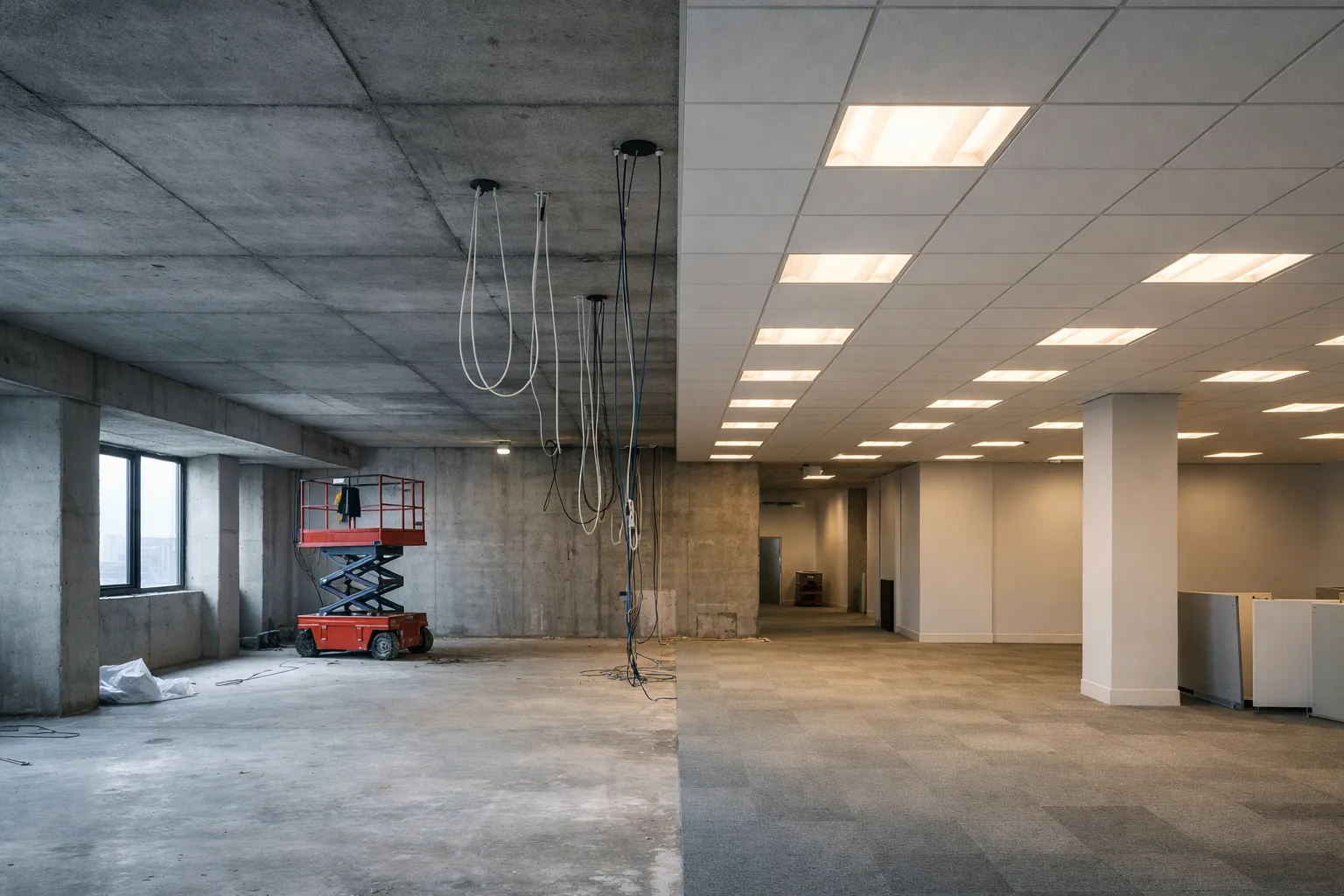
The lumen method is the arithmetic behind every preliminary lighting layout. It answers one question — roughly how many of this fitting does this room need — and it is the fastest way to sanity-check a proposal that has arrived with a suspiciously round number of luminaires on it.
Calculator
The formula it applies
And the room index, which is how you find UF:
The four inputs people get wrong
Mounting height is above the task plane
Hm is measured from the luminaire down to the working plane, not to the floor. For a 2.8 m ceiling and desk work at 0.75 m, Hm is 2.05 m, not 2.8 m. Using floor height inflates the room index, sends you to the wrong column of the UF table, and quietly under-counts fittings.
Luminaire flux, not module flux
Run this calculation once per candidate product and it also answers the compliance question, because luminaire count multiplied by measured input power over floor area is the lighting power density a building energy code caps.
Datasheets sometimes lead with the LED module output and place the luminaire output — after optics, diffuser and thermal derating — further down. The lumen method needs the second one. The gap between them is routinely 10–20%, occasionally much more with heavy diffusion.
Utilisation factor is specific to the luminaire
UF is the proportion of luminaire flux that reaches the working plane, and it depends on the fitting's distribution, the room index, and the ceiling, wall and floor reflectances. It comes from the manufacturer's UF table for that specific product. There is no universal value, which is why this calculator asks for it rather than inventing one. If a supplier cannot produce a UF table, they probably cannot produce a photometric file either.
For a direct fitting in a normally reflective room, UF often lands somewhere around 0.5 to 0.7, rising with room index. Low room index (tall narrow spaces), dark surfaces, or indirect distributions push it well down. Treat those as a smell test for a value that has been typed in wrongly, not as a substitute for the table.
Maintenance factor is four numbers
MF = LLMF × LSF × LMF × RSMF. The habitual 0.8 is a placeholder. See our note on maintained versus initial illuminance for what each term depends on and which one LED installations usually get wrong (it is the cleaning term, not the lamp term).
What this calculation cannot do
The lumen method produces an average illuminance over a rectangular empty room with a regular layout. It knows nothing about:
- Uniformity. It cannot tell you whether the result is even. Spacing-to-height ratio governs that, and it is the reason you cannot simply halve the fitting count and double the output.
- Obstruction. Racking, partitions, machinery and beams all remove light the UF table assumed would arrive.
- Non-rectangular rooms, L-shapes, atria, or anything where the room index is not meaningful.
- Task-versus-surround structure. The standard asks for a stepped illuminance around the task area; an average tells you nothing about it.
- Daylight and controls. Both change the energy answer completely, and neither appears here.
For anything being built, this number gets you to a credible fitting count for a budget, and then a proper calculation in a photometric package — with the real geometry, real reflectances and the manufacturer's photometric files — produces the layout. Use this to check that the proposal you were sent is in the right postcode.
Sources and further reading
- CIBSE Code for Lighting / SLL Lighting Handbook — the lumen method, room index definition and utilisation factor tables.
- CIE 97 — maintenance factor structure.
- EN 12464-1 — maintained illuminance, task/surround structure and uniformity requirements the lumen method does not address.