Selection & calculation
DALI-2 and D4i: what certification buys you, and what commissioning has to leave behind
The difference between "DALI compatible" and DALI-2 certified, how the bus budget and address limits constrain a design, what D4i adds inside the luminaire, the six documents a handover pack must contain, and the failure that turns a working system into an unmaintainable one.
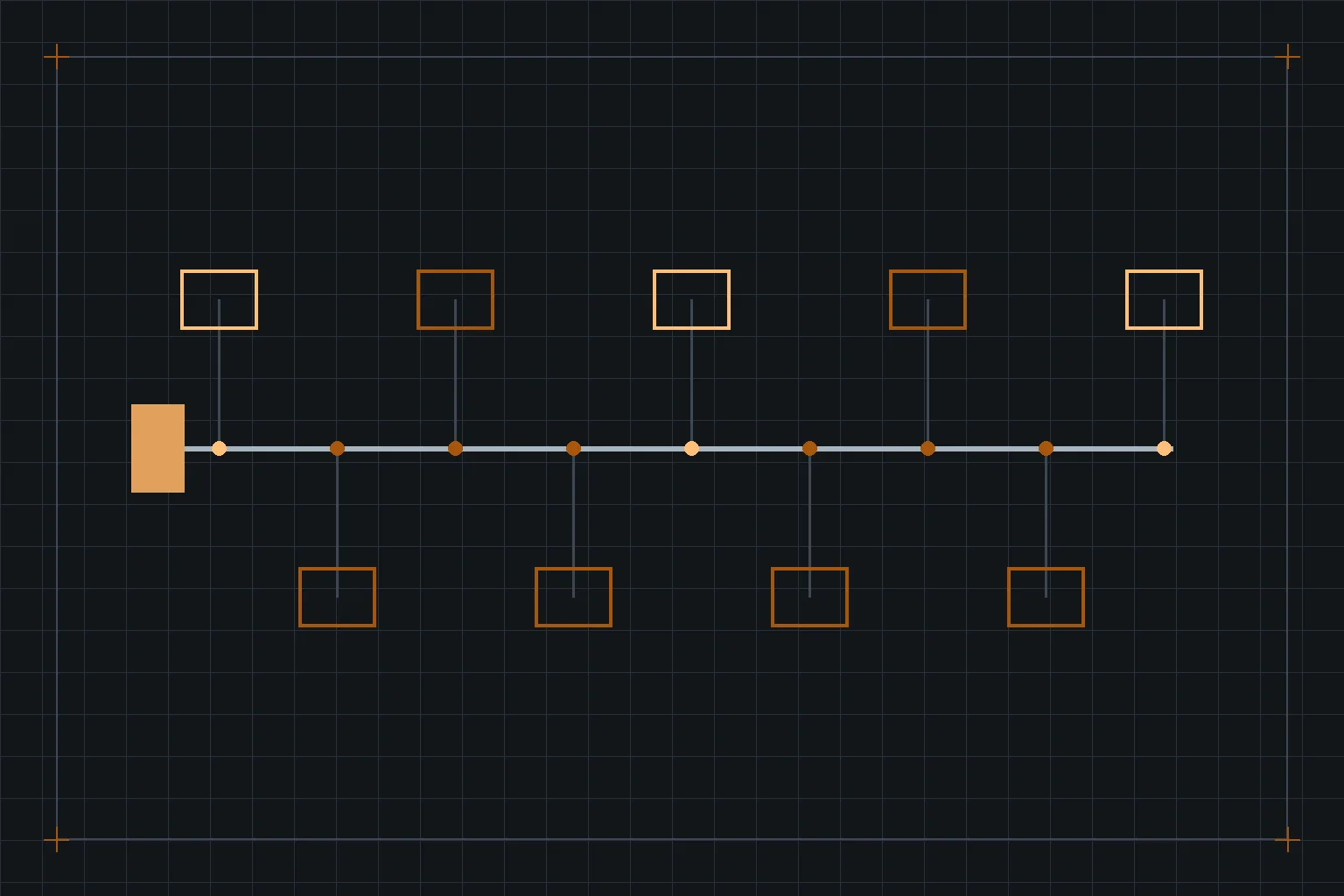
A DALI installation fails in a characteristic way, and it is almost never electrical. The system works perfectly at handover. Eighteen months later a fitting is replaced, the replacement arrives at factory default, nobody has the addressing schedule, and the facilities team discovers that restoring a room to its commissioned state requires the commissioning engineer who has since moved on. The bus is fine. The record of what was done to it is gone.
"DALI compatible" is not a claim about anything
DALI is defined by the IEC 62386 series, and since the DALI-2 revision the parts cover control devices — the sensors, panels and application controllers — as well as the gear being controlled. What matters commercially is that DALI-2 comes with a certification programme and a public register, and the phrases used in datasheets do not distinguish between products that went through it and products that did not.
- DALI-2 certified means the product was tested against the relevant parts and is listed by the DALI Alliance. You can check the listing yourself, without asking the supplier, on the Alliance's register.
- "DALI compatible", "DALI ready", "supports DALI" are marketing statements with no defined test behind them. They are frequently true and occasionally mean the device speaks a subset that works with one manufacturer's controller.
The practical consequence appears at integration, not at purchase. Mixed-vendor systems are the normal case in commercial buildings, and interoperability is exactly what certification tests. Requiring certification costs almost nothing at tender and is very expensive to add afterwards.
The three limits that constrain the design
A DALI line is not an unlimited network, and every one of these has to be checked at design stage rather than discovered by an installer.
- 64 short addresses per line. Emergency gear, sensors and panels consume from the same space in a DALI-2 system. A design that counts only luminaires will run out.
- The current budget. Every device draws from the bus power supply, and the total has to sit under what the supply provides with margin. Control devices draw considerably more than gear does, so a line with many sensors runs out of current long before it runs out of addresses.
- The voltage drop along the bus. The specification sets a maximum permitted drop between supply and the furthest device, which in practice caps the run length for a given conductor size. Take the current figures from the standard rather than from memory; "300 metres" is repeated widely and is a conclusion from one set of assumptions, not a rule.
IEC 62386-202 covers DALI emergency lighting control gear, and putting it on the lighting line is what makes automatic testing possible. It also means the emergency system's function now depends on the lighting bus, its power supply and its configuration — which the testing regime in EN 50172 will hold you to. Decide deliberately whether emergency sits on its own line; do not let it be decided by whoever was pulling the cable.
What D4i adds, and where it earns its place
D4i is a certification layer over DALI-2 aimed at intra-luminaire use: the bus power supply lives inside the fitting, and the driver is required to hold standardised data — luminaire identification, operating time and energy metering, diagnostic and maintenance data — in defined memory banks that any compliant system can read.
That combination is what makes a connected outdoor luminaire practical: a Zhaga socket on top of the fitting, a controller module plugged into it drawing power from the driver, and a data set the controller can read without a vendor-specific integration. For an indoor office scheme with a conventional control system, D4i is often more than the application needs. For a street lighting or estate scheme with remote management, specifying it is the difference between a maintainable asset and a set of fittings that each need their own gateway.
The energy reporting is worth a second look wherever a project has to evidence savings after the fact rather than estimate them beforehand — it turns the measurement and verification problem discussed in retrofit payback into a query rather than a metering exercise.
Commissioning: the part that gets skipped
Commissioning a DALI system means assigning short addresses, arranging devices into groups, setting scene levels, binding sensors to the zones they control and setting their timeouts and daylight thresholds. All of that is configuration held in the devices, and none of it is visible by looking at the installation.
The failure mode is not that it is done badly. It is that it is done well, by somebody competent, using a laptop, and then no record leaves the site. Everything about the system that a future maintainer needs exists only in the devices and in that engineer's memory of what they meant.
An addressing schedule mapping short address to physical location and drawing reference. A group and scene table saying what each group is and what each scene was set to and why. A bus topology drawing showing lines, power supplies and where each device sits. The bus power budget calculation. An exported backup of the configuration file from the commissioning tool, in a format the tool can re-import. And the name and version of that tool — because a configuration file is worthless without the software that reads it.
Specification clauses
- All control gear and control devices DALI-2 certified and listed by the DALI Alliance, with the listing reference given at tender rather than after award.
- Where remote management or in-luminaire energy reporting is required, D4i certified drivers, and the socket standard named if the fitting takes a plug-in controller.
- A bus loading calculation per line submitted with the design, covering address count, current budget and voltage drop, with the design margin stated.
- The six handover documents above listed as named deliverables, tied to a payment milestone. This is the clause that decides whether the system is maintainable, and it is the one most often absent.
- A witnessed re-commissioning of one replaced fitting as an acceptance test: swap a luminaire, restore it to its commissioned state using only the handover pack, and time it. Any system that fails this test has failed the requirement regardless of how well it works on the day.
Sources and further reading
- IEC 62386 series — the DALI standard, including the DALI-2 parts covering control devices and part 202 for emergency lighting control gear.
- DALI Alliance — the certification programme and the public register of certified DALI-2 and D4i products.
- Zhaga Consortium — the socket and interface specifications used where a plug-in controller sits on the luminaire.
- EN 50172 / BS 5266-1 — the emergency lighting testing regime that an automatic test system has to satisfy.