Acceptance & QC
Burn-in: what a 72-hour soak test can and cannot prove
Why early failures cluster, what a pre-installation soak test actually catches, why accelerated ageing cannot validate a lumen maintenance claim, and a practical protocol for buyers without a laboratory.
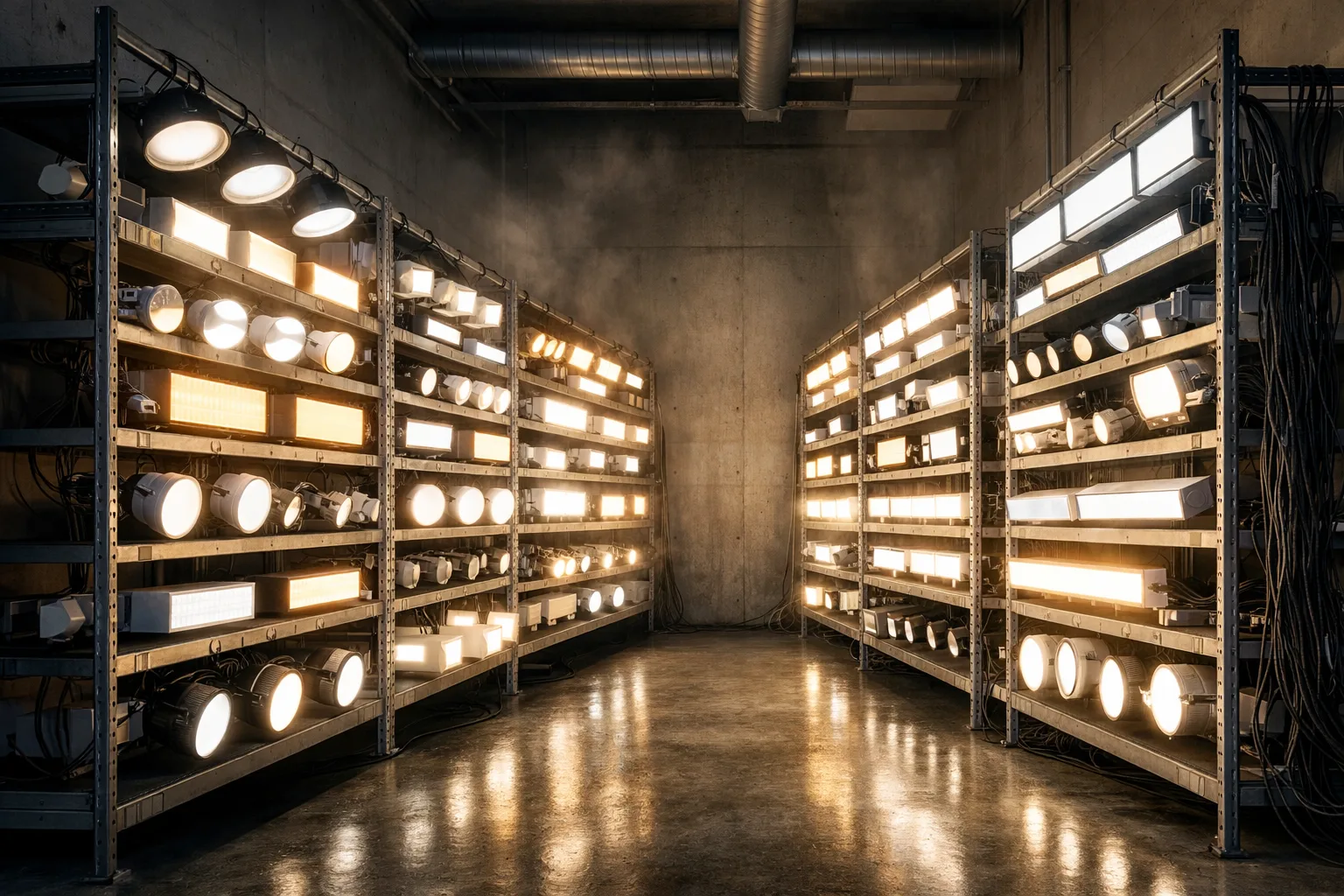
The argument for running fittings before installing them is simple: it is far cheaper to discover a dead unit on a bench than on a ceiling. The argument against is that people expect burn-in to prove things it cannot, and then treat a passed soak test as a lifetime guarantee.
Why early failures cluster
Electronic assemblies fail on a bathtub curve. There is an elevated failure rate at the start — infant mortality — then a long flat period of low random failure, then a rising wear-out phase.
Infant mortality is manufacturing, not design: a marginal solder joint, a capacitor damaged in handling, a connector not fully seated, a component from a bad reel. These fail early, under load, and they fail fast. That is precisely what a soak test is for.
| Catches | Does not catch |
|---|---|
| Dead on arrival units | Lumen maintenance over life (L70/L80) |
| Marginal solder joints under thermal load | Long-term colour drift |
| Driver components damaged in handling or transit | Electrolytic capacitor wear-out |
| Intermittent connections that only appear hot | Gasket and seal ageing |
| Thermal runaway from a bad thermal interface | UV degradation of polymers |
| Flicker that only develops once warm | Corrosion |
Why accelerated ageing does not shortcut a lifetime claim
The tempting idea is to run fittings hot for a few hundred hours and use an Arrhenius relationship to convert that into thousands of hours at normal temperature. It works for some failure mechanisms and not for the one people want it for.
The problem is that a luminaire ages by several mechanisms at once, with different activation energies — LED phosphor degradation, encapsulant yellowing, electrolytic capacitor drying, solder fatigue — and they do not accelerate at the same rate. Push temperature high enough to get useful acceleration and you also change which mechanism dominates, so the failure you produce is not the failure that would have occurred in service.
This is exactly why the industry uses LM-80's long, slow measurement at controlled temperatures rather than a short hot test, and why TM-21 caps extrapolation at a multiple of the measured duration. If a supplier offers accelerated ageing as evidence of a lumen maintenance figure, that is not what the method supports — see what a 50,000 hour claim is allowed to mean.
Comparative screening during development — does design B survive better than design A — and qualification against a defined test such as damp heat or thermal cycling. Both are useful. Neither produces an hour count.
A protocol for buyers without a laboratory
This is deliberately modest. It needs a power meter, a lux meter, a thermocouple and a corner of a room.
- Sample across the delivery, as for incoming inspection — different cartons and pallet positions, not five units off the top.
- Record the incoming baseline first. Input power, power factor, relative illuminance on the fixed jig, colour against the retained sample, flicker screening. Without a baseline the soak test proves only that the unit still works, not whether anything changed.
- Run for 72 hours continuously at rated supply, in a mounting that represents the real installation rather than open air. Twenty-four hours catches the grossest failures; 72 is a reasonable compromise between confidence and schedule.
- Include the switching cycles. If the installation will be switched frequently, add a timer cycling a subset — an hour on, ten minutes off. Thermal cycling stresses solder joints in a way continuous operation does not, and switching stresses drivers at inrush.
- Measure the case temperature at the Tc point once stable, and compare against the datasheet limit. A unit running above its declared Tc in the real mounting is a finding regardless of whether it survives.
- Repeat the baseline measurements at the end and compare. What you are looking for is not the absolute values but the deltas: output down more than a few per cent, power drifted, flicker appeared, colour moved.
- Log everything, including the units that passed. The value compounds across deliveries — you build a picture of what normal looks like for this supplier, and an outlier batch becomes obvious.
Interpreting the result honestly
A clean 72-hour soak on a sample of units means: this delivery does not have a gross workmanship problem in the units tested. That is genuinely worth knowing and it is the whole claim.
It does not mean the batch will make its rated life, that colour will hold, or that the driver will survive the ceiling void it is going into. Those depend on LM-80 and TM-21 data for the package, a driver life figure at its actual case temperature, and a thermal design validated in situ — all of which are documents to be requested, not tests to be run in a corridor.
Recording the soak so the result survives a dispute
A soak test that produces a verbal "they all still worked" is worth very little three months later when a claim is being argued. The protocol above only becomes evidence if it is written down in a form the supplier can check, so record the following for every unit in the sample, at baseline and again at the end of the run.
- Input power at nominal supply voltage, from a true-RMS power meter rather than a clamp ammeter multiplied by 230. A non-unity power factor and a distorted current waveform make the arithmetic version wrong by more than the drift you are trying to detect.
- Relative output from a fixed jig — same mounting, same distance, same sensor position, same ambient. The absolute value is meaningless; the ratio of end to baseline is the measurement, so nothing in the geometry may move between the two readings.
- Case temperature at the Tc point, with the sensor bonded, not held. Note the ambient alongside it, because a Tc reading without its ambient cannot be compared with the manufacturer's figure.
- Supply voltage and ambient temperature logged through the run, not spot-checked. A soak carried out over a weekend in an unheated corridor is a different test on Saturday night than on Monday morning.
Then state the acceptance rule before the run starts, not after. A defensible one for a delivery check is: no unit fails to light, no unit drifts more than 5 % in relative output, no unit exceeds the declared Tc, and no unit shows a visible colour change against the others in the sample. Fixing the threshold in advance is what stops the test from becoming an argument about whether 4 % is a lot.
Keep the raw sheet, the jig photograph and the instrument model and calibration date with it. Every one of those is something a supplier will ask for if you reject a batch, and the absence of any of them turns a defensible rejection into a negotiation.
What to require of the supplier instead
The soak tells you about this delivery. What predicts the fifth year is the thermal condition the gear runs at, and the measurement that establishes it is described in reading the Tc point.
Your soak test is a check on the delivery. The evidence of design adequacy has to come from the manufacturer:
- Whether production burn-in is performed, for how long, on every unit or on a sample, and what the reject criteria are.
- LM-80 data for the package with test duration and case temperatures, and the TM-21 projection with L and B values.
- In-situ temperature measurement for the finished luminaire in the worst-case mounting.
- Driver rated life at its actual case temperature, quoted separately from the LED figure.
- Qualification test reports where the environment demands them — damp heat, thermal cycling, salt spray for coastal installations.
Sources and further reading
- IEC 62722-2-1 — LED luminaire performance requirements and declared values.
- IES LM-80 and TM-21 — the measurement and projection basis for lumen maintenance, and the reason short hot tests are not a substitute.
- IEC 60068 series — environmental testing procedures, including damp heat and thermal cycling.
- ISO 9227 — salt spray testing, relevant to coastal and industrial installations.