Selection & calculation
Light where it was not wanted: trespass, sky glow and the environmental zone you were assigned
The four obtrusive light quantities a planning condition actually controls, why environmental zone decides everything and is set before you are appointed, how a pole-retained retrofit makes trespass worse, and the measurement that settles a complaint.
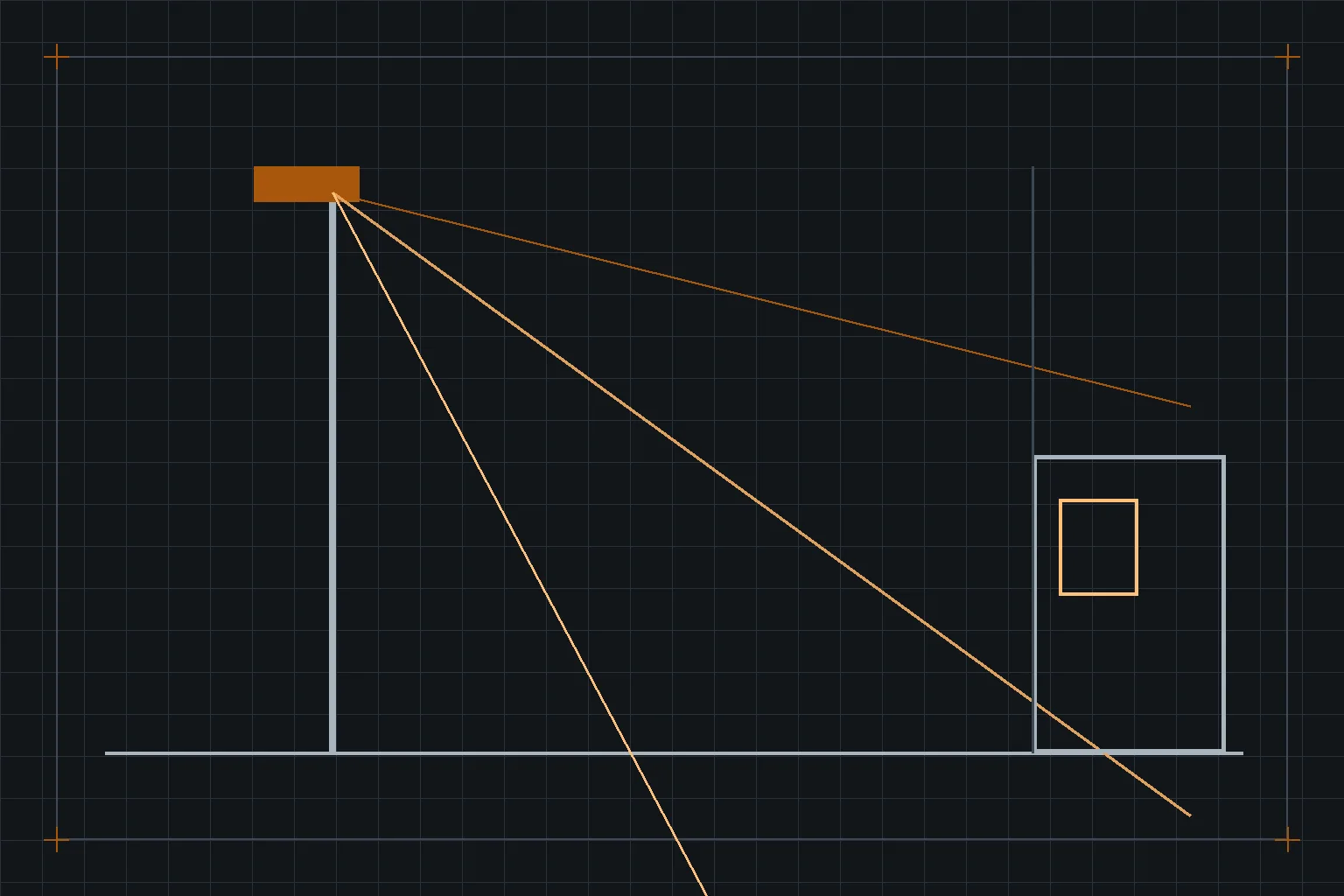
Outdoor lighting is the only part of a lighting scheme where the people affected by a design decision are usually not the client. A car park lit to a perfectly reasonable standard produces a bedroom window across the road at an illuminance nobody specified and nobody measured, and the mechanism that resolves it is a planning condition, an environmental health officer and a complaint — not a lighting standard.
Four quantities, four different complainants
"Light pollution" collapses several distinct effects into one phrase. Guidance documents separate them because they are controlled by different design decisions.
- Light trespass — illuminance falling on a neighbouring property, assessed as vertical illuminance at the plane of a window. This is what a residential complaint is almost always about.
- Source intensity — the luminous intensity of the fitting itself in the direction of the observer. A low trespass figure with a bright visible source is still a complaint, because the eye responds to the source, not to the plane.
- Upward light — the proportion of output emitted above the horizontal, which contributes to sky glow. Controlled directly by optic choice and mounting angle.
- Building luminance — for façade lighting, the average luminance of the lit surface, which is the quantity that makes a floodlit building either elegant or an amenity problem.
Environmental zone is the whole answer
Every one of those quantities has a limit that depends on which environmental zone the site sits in. The zones run from an intrinsically dark landscape at one end to a high-district-brightness city centre at the other, and the limits between the extremes differ by more than an order of magnitude. CIE 150 sets out the framework; national guidance — in the UK, the ILP's guidance notes on obtrusive light — gives the numbers that a planning authority will actually quote.
Two things follow, and both are procedural rather than technical. First, the zone is usually determined by the local authority and appears in a planning condition, which means it is fixed before the lighting designer is appointed and is not negotiable at design stage. Second, most zones impose a curfew, after which the limits tighten sharply or fall to zero. A scheme that complies all evening and has no curfew behaviour is non-compliant from 23:00, and retrofitting a curfew to an uncontrolled installation means new control gear on every column.
The planning condition, its environmental zone and its curfew time are the design brief for the obtrusive light aspect of the scheme. Ask for them at the first meeting. A design produced without them has a substantial probability of needing new optics, and optics are not a value-engineering item — they are the thing that determines whether the scheme complies.
Why keeping the poles makes it worse
The commonest outdoor retrofit brief is to replace the heads and keep the columns, because the columns are the expensive part and the civils are disruptive. It saves real money and it changes the obtrusive light situation in a direction people do not anticipate.
The old discharge lantern had a broad, soft, poorly controlled distribution. Reaching the required illuminance between widely spaced columns meant throwing light a long way sideways, and a good deal of it left the site — but it left the site diffusely, from a large, dim-looking source behind a bowl. The LED replacement on the same column has a small, intensely bright emitting area and a sharply defined distribution. To reach the same spacing it needs high intensity at high angles, which is precisely the direction that produces both trespass and source intensity complaints, from a source that looks far brighter to a neighbour than the thing it replaced.
The result is a scheme that measures better on the road and worse at the boundary, and it is why an outdoor retrofit needs its obtrusive light assessment redone rather than inherited. The related trap — that the same spacing needs a different distribution and the uniformity quietly collapses — is covered in illuminance shortfall after retrofit.
The measurement that settles a complaint
When a complaint arrives, the argument is won or lost on whether the measurement was taken in a way the other side can reproduce. Record all of it:
- Vertical illuminance in the plane of the affected window, with the meter's sensor in that plane and facing the source — not a horizontal reading taken on the ground below.
- The height and position of the measurement, referenced to something permanent, so it can be repeated.
- The residual reading with the installation switched off, taken at the same point on the same night. Street lighting, neighbouring premises and moonlight all contribute, and the quantity in dispute is the difference.
- Time, date and the operating state — before or after curfew, and at what dim level if the scheme dims.
- The meter, its class and its calibration date. The spectral mismatch of a cheap meter against an LED source is large enough to matter at these low levels; the f1′ index and what it does to a reading is discussed in illuminance shortfall.
Design moves, in order of effectiveness
- Optic selection. A distribution with a sharp cut-off at the boundary does more than any amount of dimming. This is chosen at specification and cannot be added later.
- Mounting angle. Tilting a flat-glass lantern upward to gain reach converts a compliant fitting into a non-compliant one; a specification should state the maximum tilt and the commissioning check should verify it on site.
- Shields and louvres where geometry forces a compromise. They cost light and are an admission that the optic is not quite right, but they solve a specific window.
- Curfew dimming profile, which handles the time dimension and nothing else — a scheme that trespasses at 20:00 still trespasses, at whatever percentage.
- Column position and height. Frequently the real answer, frequently unavailable on a retrofit, and worth pricing anyway so that the client is choosing rather than discovering.
Sources and further reading
- CIE 150, Guide on the Limitation of the Effects of Obtrusive Light from Outdoor Lighting Installations — the environmental zone framework and the quantities limited in each.
- EN 12464-2 — lighting of outdoor work places, for the task requirements the scheme also has to meet.
- ILP Guidance Notes for the Reduction of Obtrusive Light — the numeric limits and curfew conventions quoted by UK planning authorities.
- The planning condition for your site, which takes precedence over all of the above and is the document a complaint will be assessed against.