Selection & calculation
IP and IK ratings: what they test, and the four ways outdoor fittings fail anyway
What each IP digit is actually tested against, why a higher second digit does not always include the lower ones, the breathing mechanism that fills sealed housings with water over years, and the corrosion and UV requirements that no IP number covers.
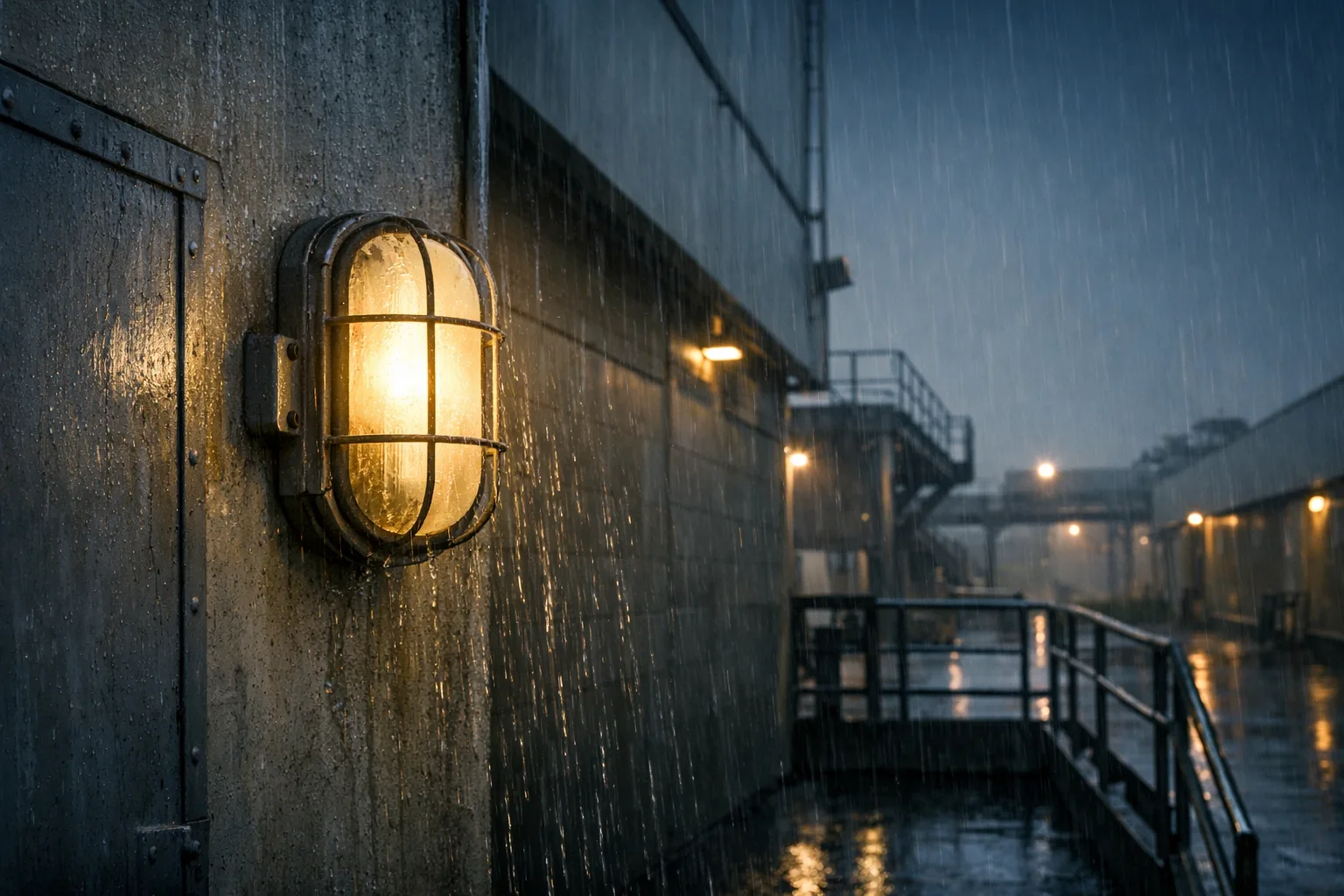
An IP rating describes a test performed once, on a new sample, in a laboratory, in a defined orientation. Outdoor fittings mostly fail for reasons that test does not simulate: years of thermal cycling, ultraviolet exposure, salt, and a cable gland that was never tightened properly. None of that is visible at delivery, which is why an ingress rating on a datasheet is worth much less than what you check when the fittings arrive.
The two digits, and what each is tested with
| Digit | First — solids | Second — water |
|---|---|---|
| 0 | No protection | No protection |
| 1–3 | Progressively smaller objects: hands, fingers, tools and wires | Dripping, dripping at 15° tilt, spraying to 60° from vertical |
| 4 | Wires ≥ 1 mm | Splashing from any direction |
| 5 | Dust-protected — some ingress allowed, must not impair operation | Water jets from a nozzle, any direction |
| 6 | Dust-tight — no ingress | Powerful water jets |
| 7 | — | Temporary immersion, defined depth and time |
| 8 | — | Continuous immersion, conditions agreed with the manufacturer |
| 9 / 9K | — | High-pressure, high-temperature close-range jets |
The misreading that matters: 7 and 8 do not include 5 and 6
An outdoor fitting has a second obligation that no ingress rating covers: keeping its light on the site it was bought for. The limits, and the environmental zone that sets them, are in light trespass, sky glow and environmental zones.
Intuition says a higher number contains the lower ones. For the water digit that holds up to 6 and then stops.
Immersion (7 and 8) and jetting (5, 6 and 9K) are physically different tests. Immersion applies steady, uniform, low pressure over the whole enclosure. A jet applies concentrated dynamic pressure at a point, and it can drive water past a seal that a static head never disturbs. A housing can pass IP67 and fail IP66.
This is why enclosures intended for both are marked with both — "IP66/IP68" — rather than with the higher number alone. If a fitting will be pressure-washed, a lone IP67 marking does not cover it, and the distinction is exactly the one that matters for car parks, food premises and agricultural buildings where washdown is routine.
State the exposure rather than the number: "subject to periodic pressure washing at close range", "submerged during seasonal flooding to 300 mm", "exposed to wind-driven rain only". Then let the supplier map that to the marking they can evidence. A bare "IP65 minimum" invites the cheapest thing that carries the label.
IK, briefly
IK (IEC 62262) rates impact resistance in joules, from IK00 to IK10 — the top of the scale being a 20 J impact, roughly a 5 kg mass dropped 400 mm. It matters for anything reachable: bollards, car park fittings, sports halls, schools, custodial and public realm.
Two practical notes. The test is against the enclosure, and a fitting is only as strong as its weakest visible face — usually the diffuser, which is why polycarbonate rather than acrylic is normal for high-IK product. And impact resistance falls as polymers age and embrittle under UV, so an IK10 rating on a ten-year-old bollard is historical rather than current.
Four failure modes no IP number covers
1. Breathing
This is the important one, and it is counter-intuitive because it defeats a perfectly sealed enclosure.
A sealed fitting heats when it runs and cools when it switches off. The air inside expands and contracts, so the enclosure pumps: it pushes air out when hot and draws it in when cold. What it draws in is humid outside air, sometimes from a surface that is wet. Each cycle the interior gains a little moisture, which condenses on the coolest internal surface. Over hundreds of cycles a genuinely IP68 housing can accumulate standing water — with no leak, no seal failure, and nothing the IP test would ever detect.
The remedy is a breathable membrane vent: hydrophobic, passes air and water vapour, blocks liquid water. Their presence in a design is a good indicator that the manufacturer has thought about the field rather than the laboratory. Ask where the vent is, and ask how it is protected from being painted over or blocked during installation.
2. Glands and entries
The IP rating belongs to the fitting as tested, with the entry sealed correctly. In the field it is defeated by a gland sized for a cable diameter it did not receive, an unused entry left open or blocked with tape, a gland hand-tightened rather than torqued, or a cable entering from above so that water runs down the sheath straight into the joint. Specify the gland size against the actual cable, require a drip loop, and require unused entries to be sealed with the manufacturer's blanking plug — not with sealant.
3. Gasket ageing
The seal is an elastomer under compression. It takes a permanent set, hardens with UV and heat, and loses its ability to recover when the housing is opened. The rating is a day-one property. After a fitting has been opened for maintenance and closed by someone who did not follow the torque sequence, it is an unknown.
4. Corrosion and UV
No IP digit describes material durability. Two separate requirements belong in an outdoor specification:
- Corrosivity category for the site, per ISO 12944 — the C1 to C5 scale, where coastal and industrial environments sit at the top. It determines the coating system and the fastener material. Stainless fasteners into an untreated aluminium housing in a marine environment produce galvanic corrosion, which is a specification error rather than a product fault.
- UV stability of every polymer part. Unstabilised polycarbonate yellows and embrittles; the diffuser loses transmission and the IK rating quietly evaporates. Ask what stabilisation is used and what the expected transmission loss is over the design life.
What to put in an outdoor specification
- The exposure described in words, with the IP marking derived from it — and both markings where washdown and immersion both apply.
- IK rating where the fitting is reachable, with the diffuser material named.
- Pressure equalisation — a breathable vent, with its position stated.
- Corrosivity category per ISO 12944 with the coating system and fastener material specified to match.
- UV stabilisation of polymer components.
- Gland schedule matched to the actual cable diameters, with blanking plugs for unused entries.
Items 3 to 6 are the ones normally missing, and they are the ones that decide whether the fitting is still working in year seven.
Sources and further reading
- IEC 60529, Degrees of protection provided by enclosures (IP Code) — the digit definitions and the test conditions behind each.
- IEC 62262, Degrees of protection provided by enclosures for electrical equipment against external mechanical impacts (IK code).
- ISO 12944, Paints and varnishes — Corrosion protection of steel structures by protective paint systems — the C1–C5 corrosivity categories.
- ISO 20653 — the road-vehicle IP variant, source of the IP69K designation commonly quoted for washdown applications.